

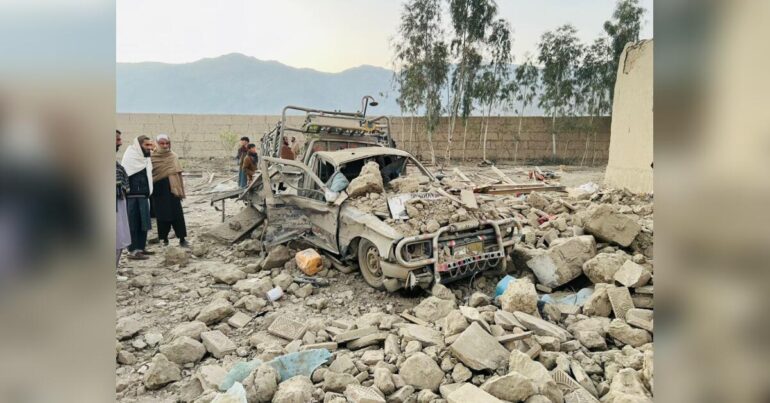

KABUL, AFGHNANISTAN – Pakistan and the Taliban administration have exchanged sharp accusations following overnight air strikes on eastern Afghanistan that Taliban officials say killed dozens of civilians, including children.
The Taliban’s Ministry of Defense said Pakistani aircraft targeted several areas in Nangarhar and Paktika provinces late on Saturday night (21 February), striking a religious school and multiple residential homes.
In a statement issued on Sunday (22 February), the ministry said “dozens of civilians, including women and children” were killed or wounded. It condemned the strikes as a “clear violation of Afghanistan’s sovereignty, international law, principles of good neighborliness and Islamic values,” and warned that it would respond “at an appropriate time.”
Zabihullah Mujahid, the Taliban spokesman, wrote on X that Pakistani forces had once again crossed into Afghan territory. He accused Pakistani generals of attempting to cover up internal security failures through such attacks. He said Ariana News that the Taliban does not target civilians like Pakistan does. He emphasized that their operations are aimed solely at those they consider the real perpetrators, specifically Pakistani military personnel.
The Taliban’s Directorate of Information and Culture in Nangarhar said 17 people, including 11 children, were killed in an air strike in the Behsud district. Five others were wounded. According to Quraishi Badlon, head of information for the directorate, Pakistani warplanes bombed the districts of Khogyani, Ghani Khil and Behsud at around midnight on Saturday. He said a civilian house in the Gardi Kach area of Behsud was hit, resulting in the reported casualties.
Taliban-run National Television reported that 25 members of a single family were killed or injured in Behsud, though it did not specify how many died and how many were wounded. Sources in Paktika province said Pakistani jets also carried out strikes in the Margha area of Barmal district, reportedly targeting a religious madrasa. Casualty figures there remain unclear.
The Taliban’s Ministry of Defense said attacks on civilian homes and religious centers were “clear evidence of intelligence and security failures within the Pakistani army” and that repeated cross-border strikes would not conceal Pakistan’s internal problems.
However, Pakistan’s Ministry of Information said earlier on Sunday that the strikes were “intelligence-based operations” carried out against seven camps and hideouts belonging to the Tehreek-e-Taliban Pakistan (TTP) and its affiliates along the Afghanistan–Pakistan border.
The ministry said the operations were conducted “with precision and accuracy” in retaliation for recent suicide bombings in Islamabad, Bajaur and Bannu, attacks it said were carried out by militants acting on instructions from leaders based in Afghanistan. “Pakistan has always strived for maintaining peace and stability in the region, but at the same time the safety and security of our citizens remains our top priority. In this back drop, Pakistan in a retributive response, has carried out intelligence based selective targeting of seven Terrorist camps and hideouts belonging to Pakistani Taliban of FAK and its affiliates and ISKP at the border region of Pakistan Afghan border with precision and accuracy.”
Pakistan refers to the TTP as “Khawarij” and has repeatedly accused the group of operating from Afghan soil. It said the TTP had claimed responsibility for recent attacks inside Pakistan.
Despite what it described as repeated requests to the Taliban authorities to take “verifiable measures” against militant groups using Afghan territory, Pakistan said “no substantive action has been taken.” It added that while Islamabad has consistently sought peace and stability in the region, “safety and security of our citizens remains our top priority.”
The Taliban, however, deny that the TTP operates from Afghanistan and say they do not allow any group to use Afghan territory to launch attacks against other countries.
Diplomatic Fallout and Regional Reactions
The Taliban’s Ministry of Foreign Affairs said it had summoned Pakistan’s ambassador in Kabul and handed over a formal protest note condemning the strikes as a violation of Afghanistan’s territorial integrity and a provocative act.
In its statement, the ministry said it had made clear to the Pakistani side that safeguarding Afghan territory is the “legal responsibility of the Islamic Emirate” and that responsibility for any negative consequences would lie with Pakistan.
The air strikes have also drawn condemnation from a number of Afghan political figures.
Former president Hamid Karzai denounced the attacks as a clear breach of Afghanistan’s sovereignty and urged Pakistan to reconsider its policies and adopt a path of “civilised and good neighbourly relations.”
Abdullah Abdullah, former head of the High Council for National Reconciliation, said the strikes violated Afghanistan’s national sovereignty and territorial integrity and risked further instability. “Bombing, targeting civilians and violence are not solutions,” he said, calling dialogue the best way to resolve disputes between the two countries.
Afghanistan’s mission to the United Nations also condemned the attacks, describing them as a violation of the UN Charter, particularly the principle of respect for territorial integrity, as well as established norms of international humanitarian law. The mission said counterterrorism efforts must be principled, coherent and fully aligned with international law, warning that selective approaches and double standards would only strengthen extremist networks and further undermine regional peace and stability. It called on Pakistan to respect international law, uphold the UN Charter and adhere to principles of good neighborliness.
Escalating Tensions
The latest strikes come months after previous Pakistani air raids on Kabul and border areas which triggered nearly a week of clashes between Taliban and Pakistani forces. Those hostilities were halted following mediation efforts by Turkey and Qatar, with subsequent talks held in Istanbul, Doha and Saudi Arabia.
Saudia Arabia intervened this month, mediating the release of three Pakistani soldiers captured by Afghanistan in October.
However, no lasting agreement was reached, and relations between Kabul and Islamabad have remained strained. The land border between the two countries has reportedly been closed for nearly five months, halting trade and cross-border movement.
With both sides trading accusations and the Taliban vowing a response, tensions between the neighboring countries appear to have deepened further following the latest cross-border strikes.

