

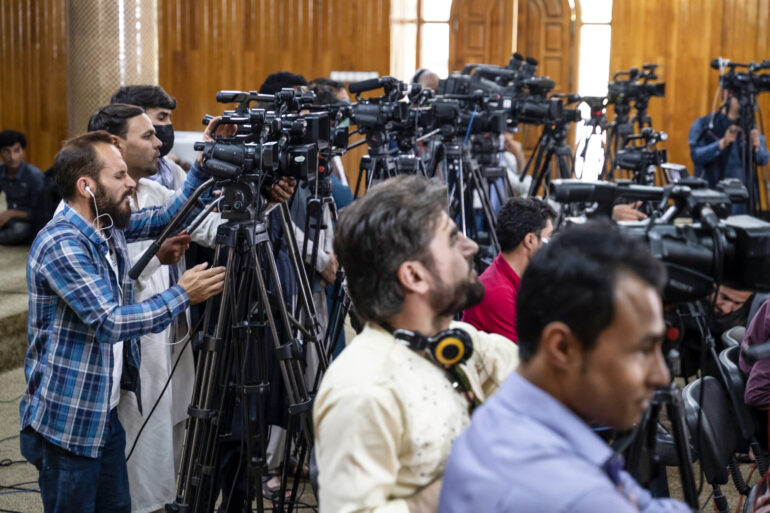

KABUL, AFGHANISTAN – The Afghanistan Journalists Center (AFJC) on Monday called on the international community, the United Nations and press freedom organizations to provide urgent and practical support to independent media outlets and journalists at risk under Taliban rule.
In a statement marking the International Day for Universal Access to Information, the AFJC said journalists and media organizations in Afghanistan continue to face severe curbs, detention, harassment and other forms of abuse because of their reporting or contacts with outlets operating in exile.
UNESCO designated September 28 as the International Day for Universal Access to Information in 2015 to promote legal guarantees of the right to information and practical access for citizens.
“Under Taliban rule, Afghanistan has moved decisively in the opposite direction,” the group said, adding that the right to access information has been “systematically dismantled and, in practice, eliminated.”
The watchdog said the Taliban have issued at least 24 directives restricting freedom of expression, access to information and media activities. These measures contravene Afghanistan’s Mass Media Law, Access to Information Law and international standards, it said.
“The people of Afghanistan today live in absolute information darkness, not because of war but because of a deliberate, official policy,” the AFJC stated. “The Taliban have declared war on the right to know — a war that has silenced journalists, severely restricted information of public interest, and stripped the public of its fundamental right to be informed.”
The group also urged the Taliban authorities to immediately revoke decrees and directives that violate media rights, end censorship and intimidation of journalists, and remove restrictions on internet access, including curbs on fibre-optic services.
“Access to information is not a privilege. It is a right — and the cornerstone of accountability,” the AFJC said. “Afghans deserve to live in a country where facts are not banned and journalists are not silenced.”
Press freedom was regarded as one of the achievements of the previous Western-backed government and among the strongest in the region. Those gains have sharply reversed since the Taliban takeover. Journalists continue to face arrests, censorship, interrogations, threats and pressure linked to their reporting, online activity or affiliations.
More than half of Afghanistan’s media outlets have closed. Many journalists have fled the country or gone into hiding. Women journalists face even tighter limits, including bans on broadcasting female voices in some provinces.
Press freedom monitors have consistently ranked Afghanistan among the world’s most restrictive environments for journalism. Reporters Without Borders placed the country 175th out of 180 in its 2026 World Press Freedom Index, citing severe restrictions on independent reporting and media operations.

