

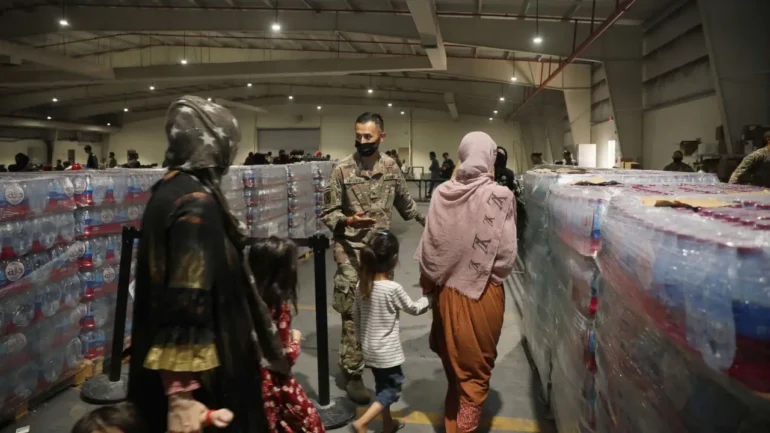

KABUL, AFGHANISTAN – Four members of the U.S. Congress have urged the secretaries of state and homeland security to make an exception for Afghan refugees stranded at Camp As Sayliyah in Qatar and allow them to enter the United States.
Scott H. Peters, Seth Moulton, Jeanne Shaheen and Richard Blumenthal sent a letter on Tuesday, September 29, to U.S. Secretary of State Marco Rubio and Secretary of Homeland Security Markwayne Mullin. In the letter, they welcomed the decision to make an exception for two Afghan family members who were transferred to the United States last week and called for the same pathway to be extended to other Afghans stranded in Qatar.
The lawmakers urged the two departments to make additional exceptions during the 2027 fiscal year so that more than 1,000 Afghans currently at Camp As Sayliyah can be transferred to the United States.
They said nearly 3,000 immediate family members of U.S. service members and veterans, as well as more than 1,000 Afghan allies, remain stranded outside the United States.
The four lawmakers also asked the State Department and Department of Homeland Security to explain to Congress within one month the legal basis for the exception that allowed the two Afghan family members to enter the United States.
They called on the administration, after providing the legal explanation, to expand the scope of the exception so that the Afghan evacuees and immediate family members of U.S. military personnel who remain stranded in Qatar could benefit from the same process.
The lawmakers’ letter came as the future of Camp As Sayliyah remained uncertain. The camp, which houses more than 1,000 Afghans evacuated by the U.S. military following the fall of Kabul, had been scheduled to close on Wednesday, September 30.
However, the United States has now agreed to keep the camp operating for another nine months, according to The Associated Press. Under the arrangement, the more than 1,000 Afghans currently housed at the facility will remain in Qatar while U.S. officials continue working on their cases.
About 1,039 Afghans are currently at the camp, with women and children making up more than 70 percent of the population, according to reports. Many have been waiting for years for resettlement in the United States following the U.S. withdrawal from Afghanistan in August 2021.
Around 150 immediate family members of U.S. military personnel are also reportedly staying at the facility while awaiting decisions on their cases.
The U.S. administration suspended the Afghan refugee resettlement programme last year, including the processing of many Afghans evacuated during and after the withdrawal. Since the suspension of the programme and the introduction of stricter restrictions on entry from Afghanistan, only a small number of Afghans have entered the United States through exceptional legal pathways. The Associated Press reported that only five Afghans had been admitted through such exceptions since the policy changes.
The situation of the Afghans at Camp As Sayliyah has attracted criticism from refugee advocacy organisations and some members of Congress. In June, reports emerged that the U.S. administration was considering relocating the Afghans to the Democratic Republic of Congo instead of resettling them in the United States. Advocacy groups and lawmakers subsequently called for the plan to be abandoned and urged Washington to allow the evacuees to enter the United States.
The nine-month extension of the Qatar camp provides additional time for the cases to be processed, but does not itself guarantee admission to the United States. U.S. officials have said they remain committed to finding a safe long-term solution for those at the facility while continuing to consider security and immigration requirements.
Following the Taliban’s return to power in Afghanistan, the United States relocated and resettled more than 190,000 former collaborators of its institutions and forces.
However, in November of last year, after the killing of a member of the U.S. National Guard by an Afghan national in Washington, the U.S. government halted its humanitarian visa program for Afghan citizens, leaving many who were still awaiting relocation in uncertainty.
This development has raised serious concerns among refugee advocates and policymakers, who warn that prolonged uncertainty and controversial relocation plans could further undermine trust in international protection systems and place already vulnerable Afghan refugees at greater risk.

