

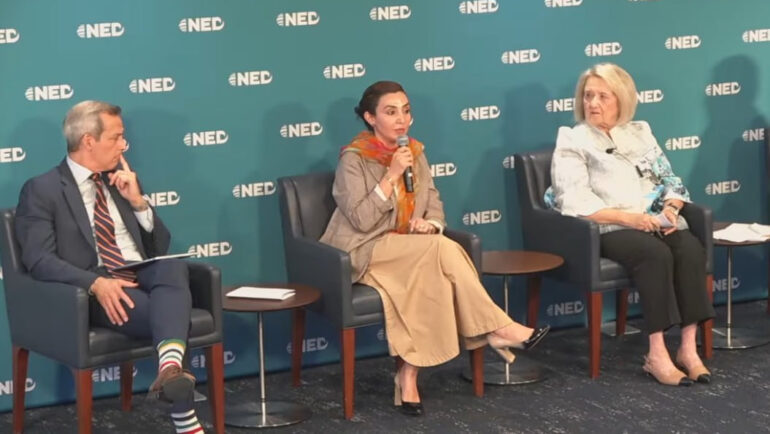

KABUL, AFGHANISTAN – Former Afghan and US officials have called for continued international engagement with Afghanistan, greater support for women and civil society, and stronger accountability for the Taliban as the country enters the fifth year since the group returned to power.
The remarks were made on Tuesday, August 25, during a program on Afghanistan organized by the National Endowment for Democracy (NED) in Washington. The event focused on Afghanistan’s political and security situation, human rights, the future of the country, and the international community’s approach to the Taliban.
Adela Raz, former Afghan ambassador to the United States; Ryan Crocker, former US ambassador to Afghanistan; and Azra Zia, president of the First Human Rights Organization and former US deputy secretary of state, were among the speakers at the event.
Speaking about the international community’s approach to the Taliban, Adela Raz said the number of countries normalizing their relations with the Taliban is increasing, with governments increasingly prioritizing their own national interests and gradually reducing restrictions on the group.
She said that although countries have not formally recognized the Taliban government, diplomatic engagement with the group is continuing at levels below ambassadorial representation. According to Raz, this has created uncertainty over the practical distinction between non-recognition and diplomatic engagement.
She argued that the international community’s approach to the Taliban should also take into account the aspirations of the Afghan people and not focus solely on the immediate political interests of individual countries.
Raz said Afghans want a future in which they have a meaningful role in determining the direction of their country and are able to enjoy fundamental rights, including access to education and employment.
She particularly emphasized the importance of women’s participation in any political process concerning Afghanistan’s future. In her view, excluding women would undermine the legitimacy and sustainability of any such process.
Raz also stressed that justice should be a central component of efforts to shape Afghanistan’s political future. She criticized previous approaches in which justice was placed behind the pursuit of peace, including during the drafting of the post-2001 constitution and the Doha negotiations.
She argued that lasting peace cannot be achieved without justice and that accountability must therefore remain an essential part of any future political transition in Afghanistan.
While Raz focused largely on the changing international approach to the Taliban and the need for an inclusive political future, Ryan Crocker, the former US ambassador to Afghanistan, warned that neglecting Afghanistan could have consequences for US national security.
He argued that developments in Afghanistan should not be treated as an exclusively domestic matter because the country’s political and security situation is connected to regional and international security, including the security interests of the United States.
Crocker referred to the experience of the 1990s, when he said the international community’s neglect of Afghanistan contributed to consequences that ultimately affected US national security. He cautioned against repeating a similar pattern.
He also called for continued support for Afghans working in education, media, human rights, women’s rights and other areas of civil society. Crocker described these groups as an important democratic force that continues to preserve hope and work toward solutions despite the difficult conditions in Afghanistan.
Reflecting on the fifth anniversary of the Taliban’s return to power, Crocker described the period as a setback for Afghanistan and said the Taliban were attempting to reshape Afghan society around a system characterized by restrictions on women and the dominance of an unelected religious authority.
Nevertheless, he expressed optimism that the Taliban would not necessarily succeed in completely reshaping Afghan society according to their vision. He pointed to Afghanistan’s educated population, civil society, independent media and other democratic forces as sources of resilience.
Crocker also recalled his experience in Afghanistan in 2001 and 2002, when efforts were made to rebuild institutions following the fall of the first Taliban government. He said reopening schools for girls was among the early priorities of the US Agency for International Development.
He recalled encountering 12-year-old girls in Kabul who, after being deprived of education under the Taliban’s first period of rule, were attending first grade alongside much younger children in an effort to regain access to education.
Crocker also referred to his visit to Bamyan, saying that while the international community was widely aware of the destruction of the Bamyan Buddha statues, the resilience of the Hazara community received far less international attention.
He described the Hazara community he encountered in Bamyan as determined and resilient, with support for women and human rights forming an important part of its efforts to rebuild the country.
According to Crocker, supporting Afghanistan’s democratic forces remains important today because the country’s security is closely connected to regional stability and US national security.
Building on concerns over the treatment of Afghans and the international community’s responsibilities, Azra Zia, president of the First Human Rights Organization and a former US deputy secretary of state, called on the US government to reconsider its approach to Afghanistan and fulfill its commitments toward Afghans who supported the United States during its two-decade military and diplomatic presence in the country.
Zia said that, five years after the Taliban’s return to power and the aftermath of the Abbey Gate attack, the focus should extend beyond remembering what was lost. She argued that policymakers should examine the current situation, identify commitments that have not been fulfilled and determine what measures are needed to address the challenges facing Afghans.
She highlighted the scale of US involvement in Afghanistan, noting that around 800,000 Americans served in the country over two decades and approximately 2,400 US service members were killed.
Zia said that during the withdrawal from Afghanistan, around 120,000 Afghan partners and allies were brought to the United States. She noted that the initial effort to receive and integrate Afghan evacuees involved military bases, civil society organizations, churches, government agencies and thousands of American volunteers.
However, she criticized the policies adopted under Donald Trump, saying that changes to US immigration policy disrupted the process of supporting Afghan evacuees and migrants.
According to Zia, the termination of the resettlement process in the summer of 2025, stricter immigration policies and the suspension of assistance to Afghanistan have affected both Afghans in the United States and the situation of women inside Afghanistan.
She expressed particular concern for Afghan women who continue to resist Taliban restrictions, as well as Afghans who fled the country because of their cooperation with the US military and government institutions but now face increasingly restrictive immigration policies.
Zia urged Washington to fulfill its commitments to Afghans and engage with Pakistan to prevent the forced return of Afghan asylum seekers.
She also called for Afghan women to be placed at the center of US policy toward Afghanistan and urged greater support for civil society and democratic institutions.
She argued that democratic institutions and civil society remain important sources of hope in Afghanistan following the dismantling of the country’s democratic system.
Zia also focused on the issue of accountability for alleged human rights violations in Afghanistan. She called on the US government to reconsider its approach toward the International Criminal Court and argued that weakening the court could make efforts to hold Taliban officials accountable more difficult.
She accused the Taliban of carrying out extrajudicial killings and torture, recruiting children into military structures and imposing systematic discrimination against women.
Zia argued that international efforts to hold those responsible for such violations accountable should be strengthened and that cooperation with international justice mechanisms could play an important role in addressing alleged abuses.
The speakers’ remarks reflected concerns over the international community’s growing engagement with the Taliban, the continued deterioration of human rights and women’s rights in Afghanistan, and the uncertain future of Afghans who have sought protection abroad.
While Raz focused on the implications of increasing diplomatic engagement with the Taliban and the need to include women and justice in any future political process, Crocker emphasized the connection between Afghanistan’s stability and international security. Zia, meanwhile, called for stronger US support for Afghan women, civil society, refugees and accountability mechanisms.

