

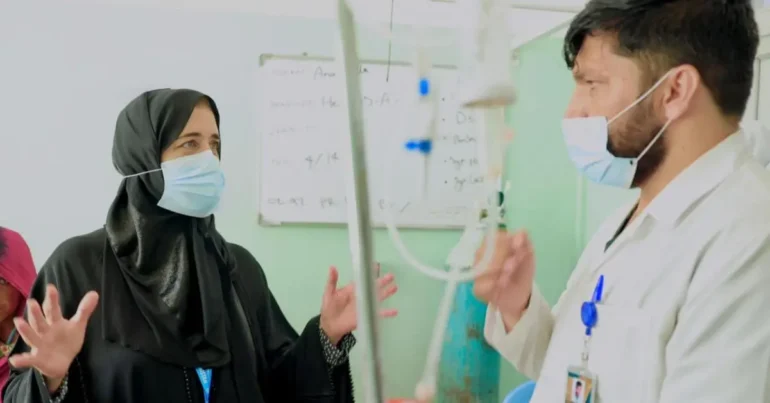

KABUL, AFGHANISTAN – Hanan Balkhy, the World Health Organization’s Regional Director, says that 150 health facilities in Afghanistan that were supported by humanitarian organizations have either suspended or ceased operations since the beginning of this year due to funding shortages.
Balkhy, who is currently in Afghanistan, wrote in a post on X that the situation has left health workers with a reduced capacity to vaccinate children, made it more difficult for mothers to access safe maternal care, and created greater obstacles for patients seeking essential health services.
She added: “These losses cannot be overlooked.”
According to the WHO official, more than 22 million people in Afghanistan require humanitarian assistance, of whom 14.4 million are in need of health services.
She further said that the 2026 Health Response Plan for Afghanistan is facing a severe funding shortfall, with only 17 percent of the required US$190.8 million received as of June 2026.
Balkhy stressed that continued investment by the international community is vital to sustain the delivery of health services, protect existing gains, and ensure assistance reaches those who need it most.
Last year, dozens of health facilities across Afghanistan also halted operations due to a lack of funding.
The warning comes as the UN Office for the Coordination of Humanitarian Affairs (OCHA) has reported that Afghanistan’s humanitarian crisis continues to worsen due to multiple overlapping challenges. In its March–April 2026 Humanitarian Update, published in May, OCHA said ongoing cross-border hostilities with Pakistan, widespread flooding, prolonged drought, climate-related shocks, mass displacement, and severe funding shortages have further strained humanitarian operations and increased the needs of millions of people across the country.
According to the report, intensified border clashes caused hundreds of civilian casualties, displaced more than 100,000 people, and damaged homes, health facilities, and schools. At the same time, flash floods affected more than 31,000 people across 31 provinces, while Afghanistan entered its sixth consecutive year of drought-like conditions, further undermining food security and rural livelihoods. OCHA also warned that funding shortages continue to disrupt essential health services and humanitarian assistance, leaving vulnerable communities with reduced access to healthcare, shelter, food, and other life-saving support.
OCHA stressed that Afghanistan’s humanitarian situation is becoming increasingly complex as conflict, climate-related disasters, economic hardship, displacement, and declining international funding reinforce one another. The agency said sustained international support and improved humanitarian access remain essential to preventing further deterioration and ensuring assistance reaches millions of Afghans in need.
The warning also comes as the forced deportation of Afghan migrants from Pakistan and Iran continues, placing additional pressure on Afghanistan’s already fragile economy and humanitarian situation.
Aid organizations have repeatedly warned that the growing number of returnees is increasing demand for shelter, employment, healthcare, and other basic services across the country.
Afghanistan has experienced a sharp increase in returns since late 2023 as Pakistan and Iran have intensified enforcement against undocumented Afghan migrants. UN figures indicate that more than 5.4 million Afghans have returned or been deported from the two countries combined since October 2023, with around 2.9 million in 2025 alone.
Nearly 150,000 Afghans have returned from Pakistan and Iran so far in 2026, according to data from the UN refugee agency (UNHCR), adding pressure on already limited resources inside Afghanistan.
The continued closure and suspension of health facilities among with the ongoing humanitarian crisis in Afghnaistan, are expected to place additional strain on Afghanistan’s already fragile healthcare system, particularly in remote and underserved areas where humanitarian-supported clinics often provide the only available medical services.

