


By Farahnaz Amini
Afghanistan has no coastline, no port, and no direct place in the maritime standoff unfolding around the Strait of Hormuz. Yet the crisis in one of the world’s most important sea routes is already being felt in Afghan markets, trade corridors, and humanitarian operations.
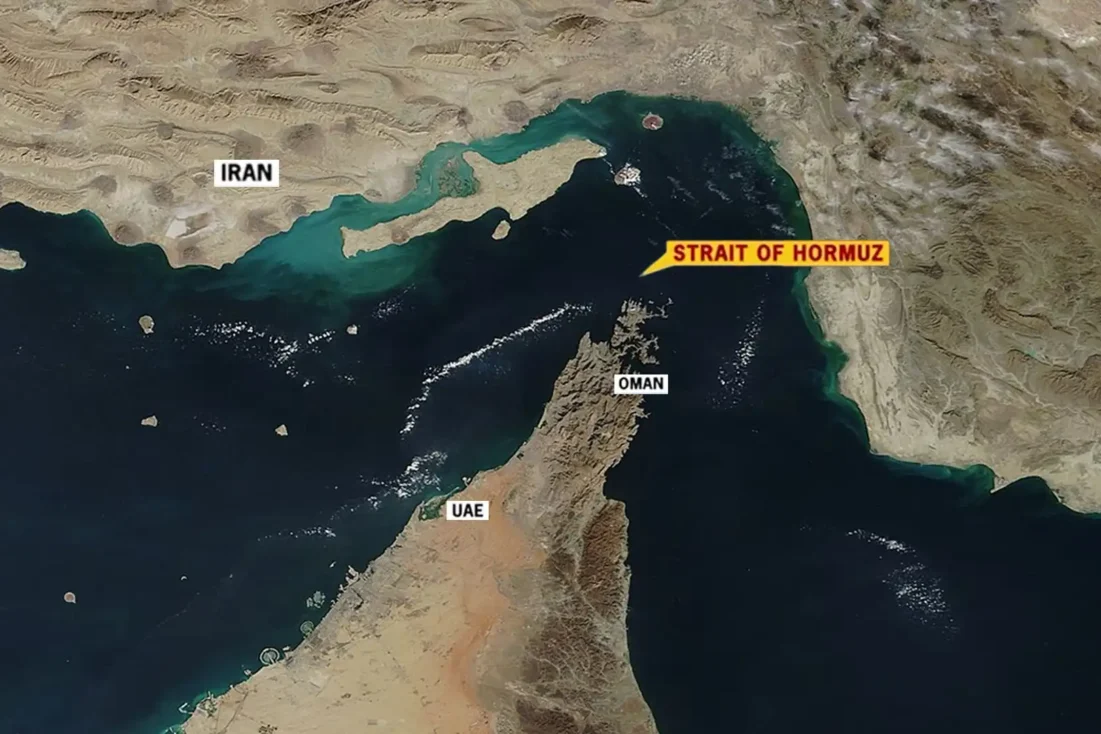
In the spring of 2026, the Strait of Hormuz—one of the world’s most important maritime chokepoints—was disrupted as tensions between Iran, Israel, and the United States escalated from late February into early March. Iranian forces declared the strait closed, deployed naval mines, and targeted vessels operating in the area, affecting a significant share of global energy shipments. For Afghanistan, a landlocked country far from the Persian Gulf, the effects were indirect but quickly visible: trade routes were disrupted, transportation costs rose, and humanitarian operations came under additional pressure.
The crisis has exposed a familiar but often overlooked reality. Afghanistan’s economy does not depend only on what happens inside its borders. It also depends on ports, roads, customs systems, border politics, and regional security arrangements controlled by others. When a major maritime route is disrupted, the shock does not stop at the coastline. It travels through supply chains, border crossings, fuel prices, and aid deliveries, eventually reaching households far inland.
The Perfect Storm: Converging Crises on Afghanistan’s Lifelines
To understand why a maritime crisis far from Afghanistan can have such serious consequences inside the country, it is important to look at Afghanistan’s long-standing dependence on transit routes controlled by its neighbors. The country’s economic problems did not begin with the Strait of Hormuz crisis. Even before tensions in the Persian Gulf escalated, Afghanistan was already facing major disruptions to its trade networks.
In late 2025, growing tensions and clashes along the Durand Line led to the closure of several important border crossings between Afghanistan and Pakistan, including Torkham and Chaman. As a result, access to Karachi Port—Afghanistan’s main gateway to international markets for decades—became increasingly difficult. Thousands of containers were delayed, trade volumes declined, and businesses on both sides of the border faced significant losses.
With the Pakistan route becoming less predictable, Afghan traders and humanitarian organizations increasingly turned to Iran as an alternative. Ports such as Bandar Abbas and Chabahar became crucial channels for imports, exports, and humanitarian supplies. Chabahar, in particular, attracted attention because it offered Afghanistan access to the Indian Ocean without relying on Pakistani territory. For many policymakers and economic planners, it represented one of the most promising alternatives for reducing Afghanistan’s dependence on a single transit corridor.
But the crisis in Hormuz has shown that alternative routes do not necessarily mean secure routes. Bandar Abbas, located inside the Persian Gulf, was directly affected by the disruption of maritime traffic. Although Chabahar lies outside the Strait itself, it was not immune to the wider regional instability. Rising security concerns in the Gulf of Oman increased insurance costs, pushed freight rates higher, and encouraged several shipping companies to reduce or suspend operations in the area.
For Afghanistan, the impact was quickly felt. The crisis demonstrated that even when alternative trade routes exist, they remain connected to the broader security environment of the Indian Ocean. As a landlocked country, Afghanistan depends heavily on access to neighboring ports and maritime transport networks. When instability affects those routes, the consequences move far beyond the coastline, reaching businesses, markets, and families across the country.
Economic Consequences: From Maritime Disruption to Local Markets
The economic effects of the Strait of Hormuz crisis have moved through Afghanistan’s supply chains with unusual speed. Traders have reported delays for some goods at Iranian ports, while transportation costs along overland routes have increased significantly. Rising fuel prices have also affected the cost of moving goods across the country, contributing to higher prices for food, construction materials, and other everyday necessities.
These developments have placed new pressure on Afghan businesses already operating in a fragile economy. Years of political uncertainty, declining investment, and limited economic opportunities had left many businesses vulnerable even before the latest crisis. According to reports from Kabul, economic activity in the informal sector which provides livelihoods for a large share of the population has slowed considerably. Agricultural exports such as fresh fruits and vegetables have also faced disruptions, limiting access to regional markets and reducing income opportunities for farmers. Combined with the border closures between Afghanistan and Pakistan, the Hormuz crisis has contributed to supply shortages and rising prices across different sectors of the economy.
The significance of this crisis lies not only in its immediate economic costs, but also in what it reveals about Afghanistan’s deeper vulnerabilities. Reliance on Iranian ports had increasingly been viewed as a practical alternative to uncertainty along the Pakistan route. Recent events show, however, that alternative corridors can also be affected by broader regional developments. Rather than eliminating vulnerability, they may simply shift it to another part of the regional system.
This is a wider challenge for many landlocked states. Because access to international markets depends on transportation networks beyond their borders, economic stability is often influenced by political and security developments over which they have little control. As the Strait of Hormuz crisis shows, disruptions in key maritime corridors can eventually affect local markets, businesses, and households far inland.
The Humanitarian Cost: Hunger in the Shadow of Distant Conflict
The crisis has also created serious humanitarian consequences for Afghanistan. The United Nations World Food Programme (WFP), one of the largest humanitarian actors in the country, has faced significant difficulties in delivering assistance. According to recent reports, disruptions to regional transport networks have increased the cost of delivering emergency aid and extended delivery times by several weeks. As a result, food supplies and nutritional assistance intended for vulnerable communities have experienced considerable delays.
The timing could hardly be worse. Afghanistan was already facing a severe humanitarian crisis before the latest regional tensions emerged. Millions of Afghans depend on humanitarian assistance, and even small disruptions in supply chains can have serious consequences for vulnerable households. In May 2026, WFP Afghanistan Country Director John Aylieff noted that the combination of border closures and disruptions linked to the Strait of Hormuz crisis was creating additional obstacles for humanitarian operations at a time when needs remained exceptionally high.
Delays in aid deliveries have placed additional pressure on humanitarian organizations working across the country. Distribution centers have reported shortages of some supplies, forcing agencies to adjust their operations while demand for assistance continues to grow. For families already struggling with food insecurity and rising living costs, these delays are not abstract logistical problems. They can mean fewer food items, longer waiting periods, and deeper uncertainty.
This is one of the most important lessons of the crisis. Maritime security is often discussed in terms of ships, oil, military strategy, and global markets. But for a country like Afghanistan, the same crisis can appear in a very different form: higher transport costs, delayed flour shipments, more expensive fuel, and aid convoys that arrive late.
The Afghan experience reinforces the central argument of this article: landlocked states may not participate directly in maritime conflicts, yet they often bear significant consequences when instability disrupts the transport networks on which they depend.
The Indian Ocean Context: Great Power Competition and Its Consequences for Landlocked States
The Strait of Hormuz crisis should also be understood within the broader geopolitical dynamics of the Indian Ocean region. Over the past decade, the region has become increasingly important for major powers because of its strategic trade routes, energy corridors, and growing economic significance. China’s Belt and Road Initiative, India’s investment in Chabahar Port, the continued naval presence of the United States, and Iran’s strategic position along key maritime routes have all contributed to a more competitive regional environment.
For Afghanistan, these developments create both opportunities and challenges. The Chabahar project, for example, was widely viewed as an important opportunity to improve Afghanistan’s access to international markets and reduce its dependence on transit routes through Pakistan. By connecting Afghanistan to the Indian Ocean through Iran, the project offered the possibility of greater economic diversification and regional integration.
However, the effectiveness of this corridor depends heavily on the broader political and security environment. International sanctions, regional tensions, and growing uncertainty surrounding maritime security have all affected the long-term prospects of the project. As a result, a corridor designed to strengthen regional connectivity has become vulnerable to geopolitical developments beyond Afghanistan’s control.
In Afghanistan’s case, the issue is not only about trade routes. It is also about how a smaller and more vulnerable country experiences great-power competition. Discussions of regional rivalry often focus on the interests and strategies of major states, while paying less attention to how geopolitical tensions affect countries that depend on regional infrastructure but have little power to shape its security.
The crisis also illustrates the limitations of existing international mechanisms designed to protect humanitarian and commercial flows during periods of conflict. Although Afghanistan is not a direct participant in the tensions surrounding the Strait of Hormuz, it continues to experience many of the economic and humanitarian consequences generated by the crisis. In this sense, the effects of maritime insecurity extend far beyond the immediate area of conflict and can shape the wellbeing of populations located hundreds of kilometers away from the sea.
Toward Resilience: Reducing Transit Vulnerability
The 2026 Strait of Hormuz crisis highlights the need to think more seriously about the vulnerabilities faced by landlocked countries such as Afghanistan. In the short term, several practical measures could help reduce the impact of similar disruptions in the future. These include facilitating humanitarian exemptions for aid shipments, supporting alternative transport routes through Central Asia, and improving regional coordination to ensure that essential goods can continue to reach vulnerable populations during periods of crisis. According to the World Food Programme, alternative transit options through the Caucasus and the Caspian region are already being explored, although these routes remain costly and logistically challenging.
Looking beyond the immediate crisis, Afghanistan’s experience points to a broader structural challenge. The country’s access to international markets remains heavily dependent on a limited number of transit corridors that are vulnerable to both political tensions and security disruptions. Reducing this dependence will require long-term investments in transportation infrastructure, stronger economic links with Central Asian partners, and greater diversification of trade routes.
Improving rail connectivity with neighboring countries could provide additional options for trade and transit. Investment in domestic agricultural production may also help reduce reliance on imported goods over time. Regional agreements that facilitate transit and trade for landlocked states could strengthen economic resilience and reduce exposure to external shocks.
Another area that deserves attention is the development of overland connections that are less dependent on maritime routes. Projects such as the Wakhan Corridor have often been discussed as possible avenues for strengthening Afghanistan’s economic links with regional markets. While such initiatives face significant practical and political challenges, they demonstrate the importance of exploring multiple connectivity options rather than relying on a single corridor.
Finally, the crisis raises broader questions about the position of landlocked states within the international system. Existing legal frameworks, including the United Nations Convention on the Law of the Sea (UNCLOS), provide important protection for maritime navigation, yet the challenges faced by countries that depend on those routes often receive less attention. As global trade networks become increasingly interconnected, stronger regional and international mechanisms may be needed to address the specific vulnerabilities of landlocked states during periods of geopolitical tension.
The central lesson is that resilience cannot be achieved through a single port, corridor, or transit agreement. Instead, it depends on diversification, regional cooperation, and the ability to adapt when external disruptions affect critical trade and humanitarian networks.
Conclusion
The Strait of Hormuz crisis demonstrates that maritime security issues can have far-reaching consequences for countries that are geographically distant from the source of the conflict. Afghanistan’s experience shows that landlocked states remain highly vulnerable to disruptions in regional trade and transportation networks, even when they are not directly involved in the political or military disputes that cause those disruptions.
The events of 2026 illustrate how instability in a major maritime chokepoint can affect both economic activity and humanitarian operations inside Afghanistan. Rising transportation costs, delays in the delivery of essential goods, and challenges facing humanitarian organizations all highlight the country’s continued dependence on external transit corridors and neighboring ports.
More broadly, this case challenges the common assumption that maritime security is mainly a concern for coastal states. In an interconnected regional economy, disruptions at sea can have significant effects far inland through supply chains, trade routes, and humanitarian networks. For landlocked countries, these effects are often amplified because they have fewer alternatives and less control over the routes on which they depend.
The Strait of Hormuz crisis shows that maritime insecurity does not end at the coastline. Developments in the Indian Ocean can directly influence the economic wellbeing and humanitarian conditions of landlocked states such as Afghanistan. Understanding this connection is essential for policymakers, aid agencies, and regional actors seeking to address the broader implications of security and connectivity in the Indian Ocean region.

