

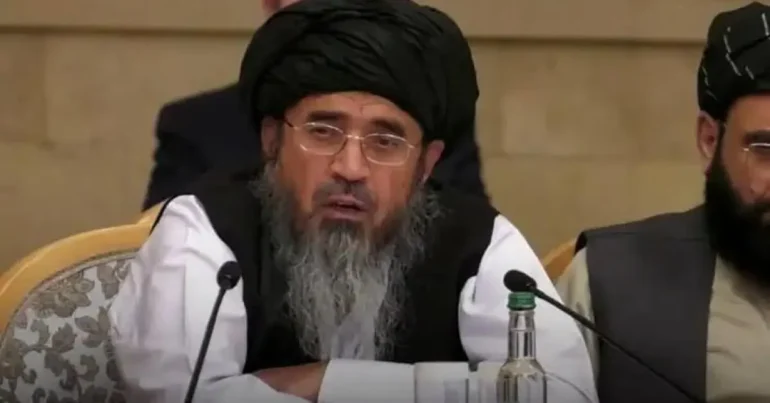

KABUL, AFGHANISTAN – Abdul Hakim Haqqani, the Taliban’s Chief Justice, has advised the group’s officials in the provinces of Kunduz, Badakhshan, Balkh, Jawzjan, and Baghlan to obey their “superiors,” stating that obedience is “a major means of strengthening and preserving the Islamic system.”
According to a statement published today (Saturday, May 17) by the Taliban Supreme Court, Abdul Hakim Haqqani emphasized during his ten-day visit to these five provinces that “every subordinate official must obey their superior.”
The Taliban’s Chief Justice also said that holding a position of responsibility is like standing before the bridge of Sirat over hell, warning that if an official fails to carry out their duties justly, they will face severe difficulty and accountability on the Day of Judgment.
He also urged Taliban officials in these provinces not to punish “criminals” arbitrarily and to treat criminals and prisoners with kindness.
Abdul Hakim Haqqani further said that they should give thanks to God for the current “Islamic system,” and that gratitude means enforcing “God’s system” upon the people of this country.
In Islamic belief, the Sirat is described as a bridge stretched over hell that every person must cross on the Day of Judgment. It is often portrayed as extremely narrow and difficult to pass, symbolizing divine judgment and the consequences of one’s deeds in life. By invoking this imagery, Haqqani was emphasizing the heavy moral and spiritual burden of leadership and warning officials that misuse of authority will bring serious consequences in the afterlife.
His remarks on obedience also reflect a broader concept in Islamic governance traditions, where obedience to leadership is often emphasized as necessary for maintaining order and stability, provided that such obedience does not require actions that contradict Islamic principles.
Classical Islamic teachings generally stress that obedience to rulers is conditional upon justice and adherence to religious law, rather than absolute submission. In this context, Haqqani’s comments frame obedience as essential to preserving the Taliban’s interpretation of an “Islamic system,” linking political loyalty to religious duty.
Since regaining control of Afghanistan, Taliban leaders have repeatedly called on their officials and the public to obey their leader and government.
They have also, in their speeches, urged their officials to observe justice, avoid oppression, and refrain from arbitrary punishment.
However, during this period, the group’s government has been widely accused of carrying out extrajudicial killings, arbitrary arrests, torture of citizens, and discriminatory and ethnic-based treatment of the people of Afghanistan.
Specifically, a newly approved Taliban criminal code, reportedly signed by Taliban leader Hibatullah Akhundzada, has raised serious human rights concerns, according to the London-based rights group Rawadari. The group says the code undermines fair trial standards by denying basic legal protections such as access to defence lawyers, the right to remain silent, and compensation for wrongful punishment.
Furthermore, Rawadari says the code formally classifies non-Hanafi Sunni groups and followers of other religious beliefs as “innovators,” a provision that could institutionalize discrimination against Afghanistan’s religious minorities, including Shiites, Ismailis, Sikhs, and Hindus.
Moreover, the code reportedly describes “rebels” as beyond reform except through execution, a clause critics warn could justify extrajudicial killings of opponents and activists. At the same time, another provision allows ordinary Muslims to punish perceived sins, significantly expanding arbitrary religious enforcement.
Taken together, these measures reinforce concerns that Taliban calls for obedience and justice are being accompanied by legal structures that centralize control while limiting rights and protections.
These remarks once again highlight the Taliban leadership’s emphasis on strict internal hierarchy and obedience as central pillars of governance, even as the group continues to face widespread criticism from human rights organizations and the international community over allegations of systemic abuses and the absence of accountability mechanisms.

