

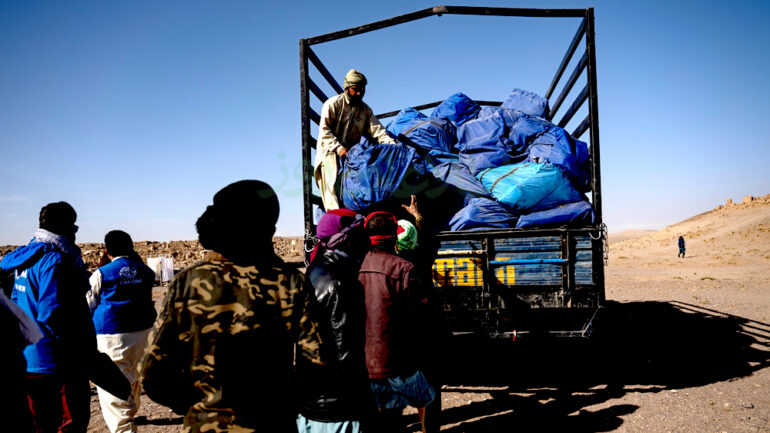

KABUL – Taliban authorities are diverting vital international aid through force, manipulation, and collusion with certain United Nations officials, according to a new report by the U.S. Special Inspector General for Afghanistan Reconstruction (SIGAR).
SIGAR’s findings draw on interviews with nearly 90 individuals, including U.S. and UN officials, as well as Afghan sources on the ground, revealing that the Taliban exert control over aid distribution, favoring Pashtun-majority regions while blocking assistance from reaching minority groups, and coercing humanitarian workers.
However, the Taliban have dismissed such allegations.
In one chilling incident, an Afghan aid worker was killed after exposing the diversion of food aid to a Taliban military camp. Responsibility for the killing remains unconfirmed.
The UN has yet to comment on the matter. Reuters notes it was unable to independently verify these allegations.
The SIGAR disclosures arrive amid a worsening humanitarian emergency in Afghanistan. A reduction in international aid, particularly from the U.S., which provided $3.83 billion of the $10.72 billion allotted between August 2021 and April 2025, has critically undermined life-saving programs for millions.
The World Food Programme has warned that half of the 15 million Afghans in urgent need of food receive no assistance; many survive on just “bread and tea.”
Hospitals are also collapsing. With sweeping cuts to U.S. aid, around 420 health facilities have closed, depriving over 3 million people of care. This includes heavy job losses among female medical staff, severely disrupting services.
Separate reports highlight that the Taliban systematically deny minority groups, especially Hazaras and Ismailis, access to government services, infrastructure projects, and humanitarian aid. In provinces like Badakhshan, Daikundi, and Bamiyan, development is deferred or withheld due to ethnic bias.
SIGAR itself acknowledges that the global aid network’s structure enables diversion, bolstered by complex bureaucracy, fragmented oversight, and fragmented organizational control.
Humanitarian operations in hostile environments like Taliban-ruled Afghanistan often benefit from opaque chains of sub-contracting and local dependence, allowing hostile actors to infiltrate and siphon off aid.
Additionally, a 2024 SIGAR report warned that insufficient vetting by the U.S. State Department of aid partners may have allowed extremist-linked groups, including the Taliban, to benefit from $293 million in aid.
The situation is compounded by tightened sanctions, shrinking donor engagement, and the Taliban’s increasingly rigid restrictions on aid operations.
The UN estimated that in 2024 alone, 23.7 million Afghans required humanitarian assistance, with women and girls bearing the brunt of service shortfalls. Only about 31% of the UN’s Humanitarian Needs and Response Plan was funded.

