

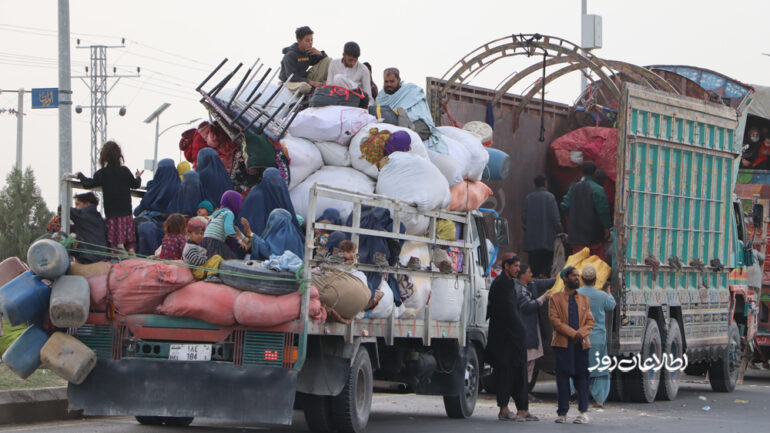

KABUL, AFGHANISTAN – A total of 380 Afghan families comprising 2,030 people returned to Afghanistan through four major border crossings with Pakistan and Iran in a single day, according to figures released by the Taliban’s Office of the High Commission for Refugees.
The data, covering Monday (August 3), shows that the largest number of returnees entered the country through the Torkham crossing on the Afghanistan–Pakistan border, where 316 families, totaling 1,739 people, were registered upon arrival.
At the Spin Boldak crossing, also on the border with Pakistan, 29 families consisting of 173 people returned to Afghanistan.
Meanwhile, 19 families with 64 members entered the country through the Silk Bridge crossing in Nimruz Province on the Afghanistan–Iran border. The office also reported that an additional 503 individual passengers crossed into Afghanistan through the same route, although it did not specify whether they were deportees or voluntary returnees.
In western Afghanistan, 16 families comprising 54 people returned through the Islam Qala border crossing with Iran.
Overall, the office said 380 families, or 2,030 people, were registered as returning to Afghanistan through the four border crossings during the reporting period.
The latest returns come as Pakistan intensifies the implementation of its Illegal Foreigners Repatriation Plan, introduced in late 2023. Last month, the Interior Ministry directed law enforcement agencies to step up the arrest of undocumented Afghan nationals and immediately detain those without valid visas, while provincial authorities were instructed to submit daily reports on enforcement efforts.
Authorities have expanded operations in cities with large Afghan populations, including Islamabad, Peshawar, Quetta, and Karachi. Local media reported that around 20,000 Afghans have been detained in Peshawar and are expected to be deported after the ongoing polio vaccination campaign concludes.
Pakistan has hosted millions of Afghans for decades, but officials say approximately 2.4 million have either returned voluntarily or been deported since the repatriation plan began. According to the UN refugee agency (UNHCR), more than 1.15 million Afghans returned from Pakistan in 2025 alone.
Iran is also home to one of the world’s largest Afghan migrant and refugee populations, including both documented and undocumented individuals. Large numbers have fled Afghanistan over decades of conflict, economic hardship, and political instability, with many arriving after the Taliban seized power in August 2021.
Iranian authorities have expanded security measures and deportation operations in recent months, detaining and returning hundreds of undocumented Afghan migrants daily to Taliban-ruled Afghanistan.
International organizations, including the United Nations, have repeatedly voiced concern over the treatment and protection of Afghan refugees and migrants, calling on states to ensure that migration enforcement respects international human rights and refugee law.

