

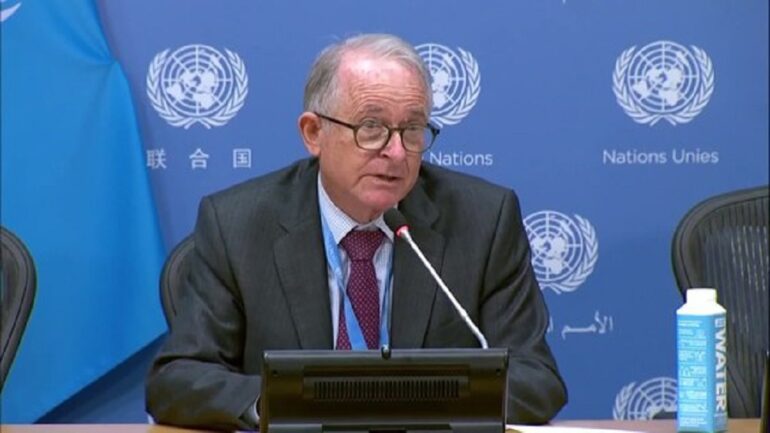

KABUL, AFGHANISTAN – The U.N. Human Rights Council on Monday extended for another year the mandate of its special rapporteur on Afghanistan, Richard Bennett, enabling him to continue monitoring and reporting on the country’s human rights situation.
The decision was taken on October 5 during the 39th meeting of the council’s 63rd session in Geneva. Resolution HRC/63/L.8, concerning the human rights situation in Afghanistan, including the extension of Bennett’s mandate, was adopted by consensus without a vote.
The extension marks the fifth consecutive renewal of Bennett’s mandate since he was appointed in 2022 as the U.N. special rapporteur responsible for monitoring and reporting on human rights in Afghanistan.
Bennett welcomed the decision in a post on X, saying the resolution provides for an Enhanced Interactive Dialogue in June 2027 focusing on gender-related concerns in Afghanistan.
The resolution also asks Bennett to prepare a study on the situation of minorities in Afghanistan and present it to the council in September 2027. The study is expected to examine the human rights situation of minority communities amid concerns over ongoing discrimination, violence and restrictions.
Bennett’s mandate was renewed as he remains barred from entering Afghanistan. The Taliban banned him from the country in August 2024 and accused him of spreading “propaganda” against the group.
Despite being unable to enter the country, Bennett has continued to gather information through online communications and engagement with Afghans inside Afghanistan and members of diaspora communities around the world. He has regularly presented reports and briefed the Human Rights Council, most recently in September.
Since assuming the role, Bennett has documented widespread rights violations including arbitrary detention, torture, extrajudicial killings, discrimination and restrictions on fundamental rights. His reports have focused heavily on the treatment of women and girls and the situation of ethnic and religious minorities.
Bennett has been highly critical of Taliban policies affecting women and girls. In his reports and briefings, he has described certain abuses as potentially amounting to “crimes against humanity” and has used the term “gender apartheid” to characterize the broader system of restrictions imposed on women and girls.
Afghanistan’s human rights situation has deteriorated significantly since the Taliban returned to power in August 2021. The group has imposed numerous decrees and restrictions affecting women and girls, including barring them from secondary and higher education, restricting access to many jobs and limiting their access to public spaces such as parks and gyms.

