
KABUL, AFGHANISTAN – The Global Campaign to Stop the Hazara Genocide has launched an international petition calling for urgent action to protect Hazaras in Afghanistan, prevent forced displacement and pursue legal recognition of the alleged genocide against the community.
The online petition urges the United Nations, its Human Rights Council, governments, national parliaments, competent international justice bodies and human rights organisations to take immediate measures to protect Hazaras, stressing that action to safeguard lives must not be delayed until legal investigations are completed.
The petition calls on the international community to take coordinated and effective action to protect Hazaras, halt atrocities, prevent forced displacement, ensure justice and investigate and legally recognise the genocide against the community.
Campaign organisers say Hazaras have endured repeated periods of mass killings, repression, forced displacement, dispossession, structural discrimination and denial of fundamental rights over more than a century.
The petition identifies the atrocities committed during the reign of former Afghan ruler Abdur Rahman Khan in the late 19th century as the beginning of a prolonged history of persecution against Hazaras. It says targeted violence, deadly attacks against civilians and discrimination based on ethnic and religious identity have continued to threaten the community’s security and fundamental rights in subsequent decades.
The signatories also point to deadly attacks in recent years on schools, educational institutions, mosques, cultural centres and residential areas associated with Hazaras, arguing that these incidents underscore the need for effective protection.
At the same time, reports of forced displacement, land seizures, structural exclusion and restrictions on fundamental rights have raised serious concerns about the community’s security, right to residence, property ownership and future, the petition says.
Hazara women and girls require particular protection because they face risks arising from ethnic and religious discrimination, as well as gender-based restrictions, according to the campaign organisers.
The petition calls on the United Nations, governments and relevant authorities to take practical measures to protect Hazara lives and prevent further atrocities against the community.
It also urges the international community to take immediate and effective action to prevent the forced displacement of Hazaras, unlawful evictions from their homes and the seizure or confiscation of their land.
The campaign further calls for the investigation and legal recognition of the genocide against Hazaras, alongside the establishment of an independent mechanism to establish the facts and document abuses against the community.
It also urges competent national and international judicial authorities to hold those responsible for alleged genocide and forced displacement accountable and to end impunity for perpetrators.
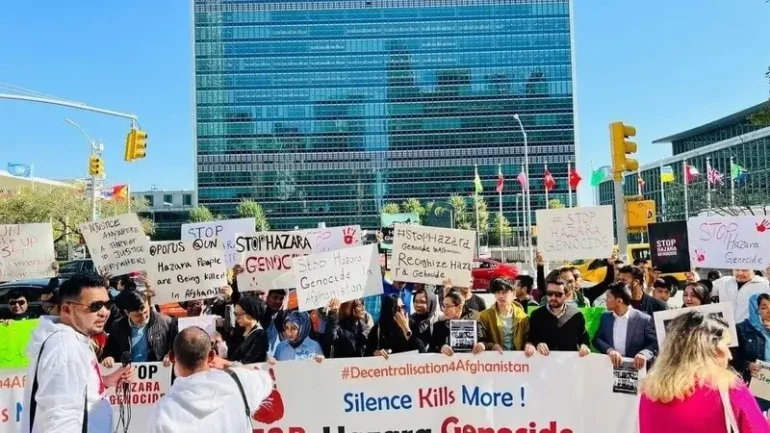
Hazara political, social and cultural activists have repeatedly organised international campaigns, demonstrations and marches in cities around the world to demand recognition of the genocide against Hazaras and an end to ongoing violence and persecution.
Activists argue that the mass killings and forced displacement of Hazaras under Abdur Rahman Khan, alongside subsequent targeted attacks, displacement and discrimination, constitute genocide against the community.
Several local and regional authorities outside Afghanistan have formally recognised the genocide against Hazaras. These include East Staffordshire Borough Council in the United Kingdom, the City of Greater Dandenong in Australia and the New South Wales Legislative Council. The parliaments of the United Kingdom and Canada have also discussed the issue, although they have not announced final decisions recognising it, according to the campaign.
The activists have also raised concerns about recent actions by Taliban authorities, including the forced displacement of dozens of rural families in Daikundi and Bamiyan provinces and the declaration of several Hazara-populated residential areas in Kabul, Ghazni, Herat and Balkh as state property.
They argue that these measures, alongside the lack of accountability for deadly suicide attacks on Hazara educational institutions and religious sites, represent a continuation of the community’s persecution and forced displacement.
The petition calls for urgent international intervention to protect Hazaras, safeguard their land and property rights, investigate alleged crimes and ensure accountability for those responsible.