

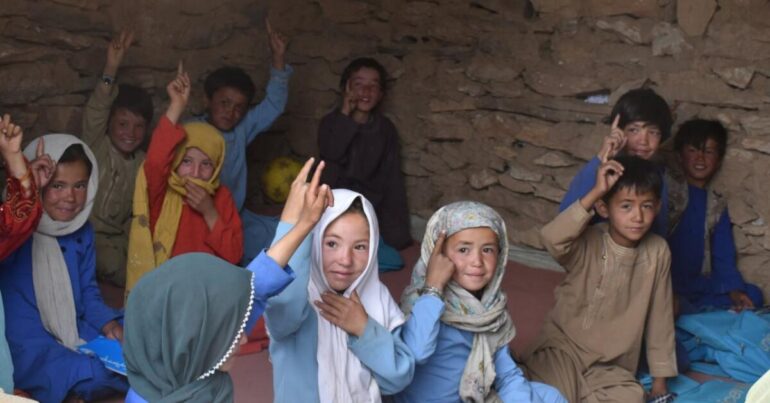

KABUL, AFGHANISTAN – The United Nations Office for the Coordination of Humanitarian Affairs (OCHA) has warned that children in Afghanistan continue to face numerous barriers to learning, marking International Literacy Day on Tuesday.
OCHA said in a message that literacy opens doors to knowledge, opportunity and a safer future. The UN humanitarian agency stressed that sustained investment in education is essential to keep those opportunities open and ensure every child has the chance to grow and thrive.
International Literacy Day is observed on September 8 each year. It comes as Afghan girls above sixth grade have been barred from attending school for nearly five years under Taliban restrictions.
The United Nations Assistance Mission in Afghanistan (UNAMA) also marked the occasion, emphasizing that everyone should have the opportunity to read and write.
UNAMA said that for 60 years, a fundamental principle has remained at the heart of International Literacy Day: every person has the right to read, write, learn and participate fully in society.
However, UNAMA said that 739 million young people and adults worldwide still lack basic literacy skills.
Afghanistan’s education crisis has deepened since the Taliban returned to power in 2021. UNESCO said in a report published on August 12 that approximately 2.4 million girls have been deprived of education since the Taliban takeover. Girls have been barred from secondary schools, while women have been excluded from universities since 2022 and continue to face restrictions on employment and participation in public life.
UNESCO said the ban on women’s access to higher education would further exacerbate the shortage of female teachers. According to the agency, more than two million primary-school-age children are also out of school for reasons unrelated to the restrictions imposed on girls and women.
UNESCO said Afghanistan is the only country in the world where girls and women are formally prohibited from secondary and higher education, warning that the restrictions could deprive the country of its human potential for decades, deepen poverty and cause lasting damage to its social and economic development.
After returning to power, the Taliban first banned girls above sixth grade from attending school before closing universities and medical institutes to women. Despite widespread international condemnation of the restrictions over the past five years, the Taliban has refused to reverse its policies.
Human rights organizations, UN experts and international advocacy groups have described the Taliban’s systematic restrictions on women and girls as a form of gender apartheid. They say the exclusion of women and girls from education, employment and public life amounts to institutionalized discrimination and has deprived them of fundamental rights and opportunities.

