

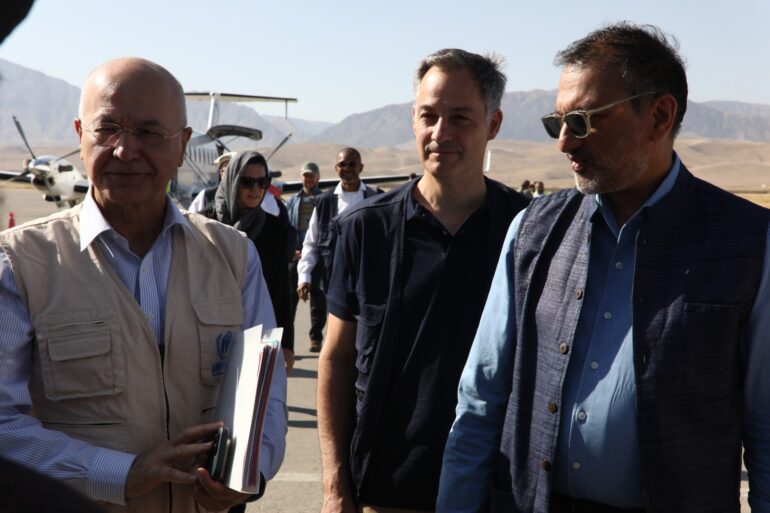

KABUL, AFGHANISTAN – Afghanistan cannot recover from its deepening humanitarian crisis without the full participation of women, senior UN officials said on Monday, urging the Taliban to lift restrictions on female education and employment.
Alexander De Croo, Administrator of the UN Development Programme (UNDP), and Barham Salih, the UN High Commissioner for Refugees, made the appeal during a joint visit to the country, according to Agence France-Presse.
“You need all hands on deck, you need all the talents that are available, and that is male talent but also female talent,” De Croo said during a visit to a carpet weaving center in the Nahr-e-Shahi district of northern Balkh province.
De Croo called on the Taliban authorities to ensure “sufficient access to education, employment, and entrepreneurship for girls and women.”
The Taliban have imposed extensive restrictions on women since regaining power in 2021, including barring girls from secondary and higher education, prohibiting women from many jobs in government and NGOs, requiring a male guardian for long-distance travel, and banning them from public parks and other spaces.
In September 2025, the authorities extended the measures by banning Afghan women from working in UN offices, a decision that has drawn repeated condemnation from the world body.
Despite numerous appeals from the UN and international partners, the Taliban have shown no indication of reversing these policies.
Salih, also on the ground in Afghanistan, described the ban on female UN staff as “a major limitation on our ability to deliver for the people of Afghanistan.” He is expected to raise the issue directly with Taliban officials during meetings scheduled in Kabul in the coming days.
“Afghanistan deserves support, but for us to be able to do so, there needs to be collaboration and cooperation,” Salih said. “We must harness the potential of this society … and that requires men, women, boys and girls be able to be mobilized to contribute to the future of their country.”
He added that Afghanistan’s development “cannot happen without” women and girls.
The economic toll of the restrictions is significant. According to a UNICEF report released in April, barriers to women’s education and employment are costing the Afghan economy at least $84 million per year.
The visit comes as Afghanistan faces one of the world’s worst humanitarian crises, driven by years of economic decline, repeated natural disasters, the mass return of refugees from neighboring countries, cuts in international aid and Taliban policies. The United Nations estimates that nearly 22 million people, almost half the country’s population, require humanitarian assistance this year, with women and children among the most vulnerable.

