

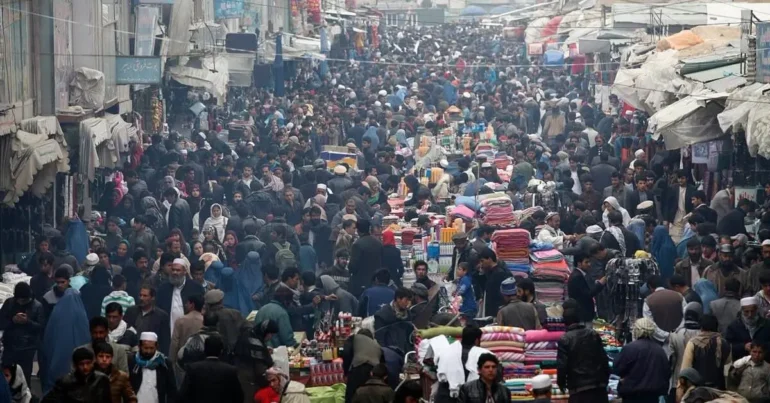

KABUL, AFGHANISTAN – The United Nations Assistance Mission in Afghanistan (UNAMA) has estimated Afghanistan’s population at 48.6 million, while the Taliban-controlled National Statistics and Information Authority says the country’s population is 37.2 million.
The two differing figures were released today (Saturday, July 11) on the occasion of World Population Day. July 11 marks World Population Day.
In a message posted on Facebook, UNAMA said that “Afghanistan’s population is projected to reach 48.6 million in 2026.”
The mission added that accurate population data and statistics provide the basis for informed decision-making and the development of effective policies and programs to improve healthcare services, promote gender equality, strengthen resilience, and advance sustainable development.
Meanwhile, Afghanistan’s National Statistics and Information Authority, which is under Taliban control, also released this year’s population estimate, placing the country’s population at more than 10 million fewer than the United Nations estimate.
In a statement, the authority said that, based on its estimates, Afghanistan’s population will reach 37.2 million in the 1405 solar year.
The authority said that men account for 51 percent of the population, while women make up 49 percent.
According to the authority’s estimates, around 70 percent of Afghanistan’s population—nearly 26 million people—live in rural areas, while another 26 percent (9.8 million people) reside in urban areas. The remaining four percent, equivalent to 1.5 million people, are nomads (Kuchis).
The authority added that Kabul, with a population of 6.4 million, is the country’s most populous province, followed by Herat with 2.4 million people.
Last year, the National Statistics and Information Authority estimated Afghanistan’s population at 36.4 million. Based on its calculations, the country’s population has increased by 2.2 percent, or approximately 800,000 people, over the past year, reaching 37.2 million.
The differing figures from the Taliban and the United Nations come despite the fact that no comprehensive and transparent national census has yet been conducted in Afghanistan.
The absence of a nationwide census for decades has made it difficult to determine Afghanistan’s actual population with certainty. Population estimates produced by national authorities and international organizations often rely on demographic models, administrative records, household surveys, and other statistical methods rather than a complete headcount. Accurate population data is considered essential for planning public services, allocating humanitarian assistance, and shaping long-term development policies.
The uncertainty surrounding Afghanistan’s population figures comes at a time when the country is facing one of the world’s most severe humanitarian crises. Regardless of the exact population estimates, millions of Afghans continue to depend on humanitarian assistance, with nearly half of the population requiring aid due to widespread poverty, food insecurity, displacement, and limited access to essential services.
Afghanistan remains highly vulnerable to recurring natural disasters, including earthquakes, floods, droughts, and the growing impacts of climate change, which have placed additional pressure on already fragile communities. The humanitarian situation has also been intensified by the forced deportation of Afghan refugees from neighboring countries, creating new waves of displacement and increasing the burden on local communities.
Under Taliban control, restrictions on women’s rights, including exclusion from education, employment, and public life, have further deepened the crisis. The systematic discrimination against women, described by many human rights organizations as gender persecution and gender apartheid, has affected not only women and girls but also Afghanistan’s broader social and economic development, making life increasingly difficult for millions of people across the country.

