

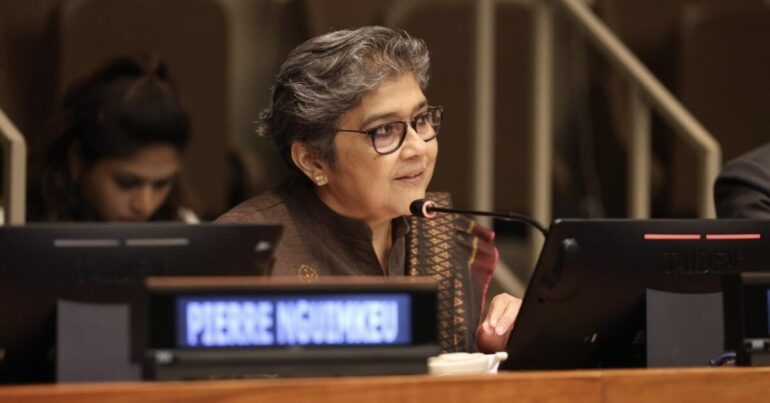

KABUL, AFGHANISTAN – UN Secretary-General António Guterres has nominated Bangladeshi diplomat Rabab Fatima as his new special representative for Afghanistan and head of the UN Assistance Mission in Afghanistan (UNAMA), sources familiar with the matter said.
If no member of the UN Security Council objects to the nomination, Fatima will succeed Roza Otunbayeva, the former Kyrgyz president and diplomat who led the mission from September 2022 to September 2024. Since then, Georgette Gagnon, UNAMA’s deputy special representative for political affairs, has served as acting head of the mission.
The UN has not yet publicly confirmed the nomination.
Fatima currently serves as UN under-secretary-general and high representative for the least developed countries, landlocked developing countries and small island developing states, a role she has held since August 2022. Before joining the UN Secretariat, she was Bangladesh’s permanent representative to the UN from 2019 to 2022 and earlier served as her country’s ambassador to Japan.
If confirmed, Fatima would become the second woman appointed as the secretary-general’s special representative for Afghanistan since the Taliban returned to power in August 2021.
The nomination comes at a critical time for UNAMA as the mission seeks to maintain engagement with Afghanistan’s Taliban authorities while responding to one of the world’s largest humanitarian crises and monitoring a deteriorating human rights situation.
Last month, the UN Security Council unanimously extended UNAMA’s mandate until June 17, 2027, while requesting a strategic review of the mission to determine whether its structure, priorities, and operations remain suited to Afghanistan’s evolving political, security, and humanitarian landscape.
The one-year renewal followed an unusual three-month extension approved earlier this year after several Security Council members, including the United States, argued that additional time was needed to assess the mission’s effectiveness and future direction.
Established in 2002 following the Bonn Agreement that laid the foundation for Afghanistan’s post-Taliban political transition, UNAMA has undergone significant changes since the Taliban’s return to power in August 2021. Its current mandate focuses on coordinating international humanitarian assistance, monitoring and reporting on human rights, and facilitating broader engagement between the Taliban and the international community.
UNAMA has faced mounting operational and political challenges under Taliban rule. UN officials have repeatedly expressed concern over restrictions imposed on women and girls, including limits on education, employment, and public participation. The Taliban authorities have also barred Afghan women from working for the UN inside the country, a move widely condemned by the international community.
Despite these challenges, UNAMA continues to serve as the UN’s principal political presence in Afghanistan and remains a key channel for humanitarian coordination and diplomatic engagement.
Afghanistan remains one of the world’s largest humanitarian crises. According to UN agencies, millions of Afghans require humanitarian assistance, while aid organizations are struggling with funding shortfalls following significant reductions in international donor support. Women and children account for the majority of those in need.

