

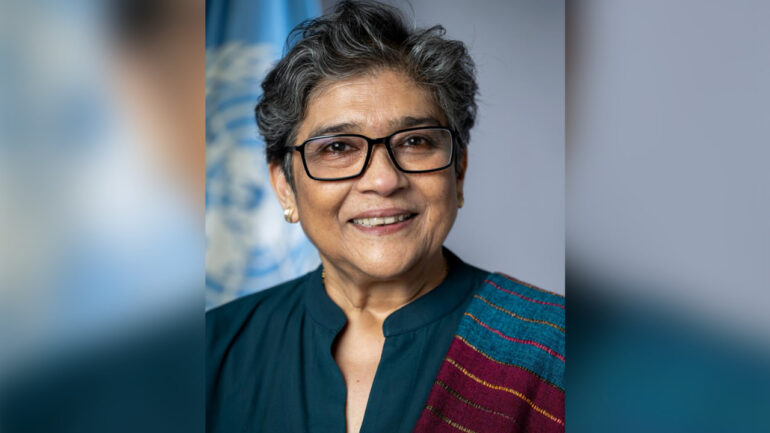

KABUL, AFGHANISTAN – United Nations Secretary-General António Guterres has appointed Bangladeshi diplomat Rabab Fatima as his new special representative for Afghanistan and head of the UN Assistance Mission in Afghanistan (UNAMA), the UN announced on Wednesday.
Ms. Fatima succeeds Roza Otunbayeva of Kyrgyzstan, who served as the UN’s top envoy in Afghanistan from September 2022 until September 2025. Guterres thanked Otunbayeva for her service and also expressed appreciation to Georgette Gagnon of Canada, UNAMA’s deputy special representative, who has been serving as officer-in-charge of the mission, the UN said in a statement.
According to the statement, Fatima brings more than three decades of experience in national and international public service, including bilateral and multilateral diplomacy, policymaking, advocacy, and programme implementation.
She currently serves as UN Under-Secretary-General and High Representative for the Least Developed Countries, Landlocked Developing Countries and Small Island Developing States (UN-OHRLLS), a position she has held since 2023.
Before joining the UN Secretariat, Fatima served as Bangladesh’s permanent representative to the United Nations from 2019 to 2022. During her tenure in New York, she chaired the executive boards of UNICEF and UN Women and became the first woman elected to lead the UN Peacebuilding Commission.
A career diplomat, Fatima previously served as Bangladesh’s ambassador to Japan and held senior positions in the country’s foreign ministry and diplomatic missions in New York, Geneva, Beijing and Kolkata. She holds a master’s degree in international relations and diplomacy from The Fletcher School at Tufts University and a bachelor’s degree in social science from the University of Canberra in Australia.
Afghanistan’s permanent mission to the UN, which is led by diplomats appointed under the former government, welcomed Fatima’s appointment and expressed hope that her experience would strengthen the mission’s effectiveness and ensure its work remains aligned with the priorities and aspirations of the Afghan people.
In a statement, the mission said it is confident UNAMA would continue to carry out its responsibilities in a “principled, impartial and effective manner,” including advocating for the protection of the rights and freedoms of all Afghans, particularly women and girls.
UNAMA was established in 2002 under the Bonn Agreement following the fall of the Taliban’s first regime. The mission has played a central role in supporting Afghanistan’s political processes, coordinating international humanitarian and development aid, and monitoring human rights.
Since the Taliban returned to power in August 2021, the mission has continued to engage with the Taliban authorities, coordinate international aid efforts and provide regular reports to the UN Security Council, despite mounting operational and political challenges.
Last month, the Security Council extended UNAMA’s mandate until July 2027 and called for a strategic review of its work and structure. It remains the UN’s most expensive mission, functioning in one of its most complex environments.
Fatima assumes the role as Afghanistan under the Taliban rule faces a complex mix of humanitarian, human rights, economic and political challenges. UN agencies estimate that nearly half of the population depends on humanitarian assistance, while aid operations continue to struggle with severe funding shortages.
The country remains largely isolated internationally, with Russia the only state to have formally recognized the Taliban authorities since their return to power in 2021. Restrictions on women and girls remain among the most contentious issues, with females barred from secondary and higher education and from many areas of employment and public life, while concerns over the rights of minorities and other vulnerable groups persist.

