

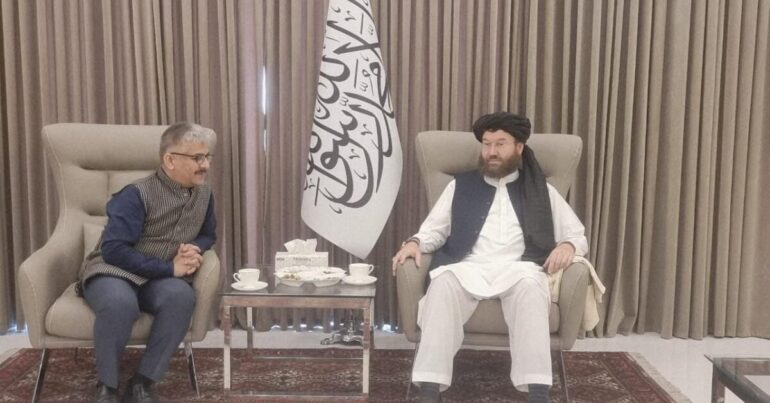

KABUL, AFGHANISTAN – Ataullah Omari, the Taliban’s Minister of Agriculture, Irrigation and Livestock, has traveled to India at the head of an official delegation.
In a statement issued today (Tuesday, July 7), the Taliban’s Ministry of Agriculture said that Omari departed for India with the aim of “expanding bilateral cooperation in the fields of agriculture and livestock.”
During the visit, Omari is expected to meet with Indian officials to discuss cooperation in agriculture, the exchange of experiences, modern agricultural technology, and the development of agricultural exports and imports.
Following the rise in tensions and the outbreak of military clashes between the Taliban and Pakistan, the group has strengthened its political and trade relations with India.
Omari is the fourth Taliban minister to visit New Delhi in the past 10 months.
Earlier, Amir Khan Muttaqi, the Taliban’s Foreign Minister, traveled to India in October 2025 for a six-day visit. In November of the same year, Nooruddin Azizi, the Taliban’s Minister of Industry and Commerce, also visited New Delhi. One month later, after the Taliban banned the import of medicines from Pakistan, Noor Jalal Jalali, the group’s Minister of Public Health, traveled to India to discuss healthcare, medical, and pharmaceutical cooperation.
India has also warmly engaged with the Taliban. In October 2025, following Muttaqi’s visit to India, New Delhi sent a chargé d’affaires to Kabul and handed over the Afghan embassy to the Taliban administration. In January of this year, India accepted Noor Ahmad Noor, a Taliban diplomat, as the acting head of the Afghan Embassy in New Delhi.
Although most countries have not formally recognized the Taliban government since it returned to power in 2021, many have maintained varying levels of engagement with the group. Several regional countries, including China, Russia, Iran, Pakistan, Turkey, India, and the Central Asian states, have accepted Taliban-appointed diplomats or continued diplomatic contacts.
Russia remains the only country to have formally recognized the Taliban government. Western countries, including members of the European Union and the United States, continue to withhold formal recognition while engaging with Taliban officials on issues such as humanitarian assistance, counterterrorism, human rights, and migration.
In recent years, European governments have also held direct talks with Taliban representatives on practical issues, including the deportation and return of Afghan migrants. For example, two weeks ago, Taliban officials were issued visas to travel to Brussels for discussions with European officials on migration and related matters, despite widespread criticism from human rights groups, UN experts, EU lawmakers, and Afghan women who warned that the engagement risked legitimizing the group. It reflects continued diplomatic engagement despite the absence of formal recognition.
Like much of the world, India has not formally recognized the Taliban regime but has gradually expanded its engagement with the group in recent years. The country, which maintained close ties with previous Afghan governments, closed its embassy in Kabul after the collapse of the former administration but reopened it in 2022 at a limited, technical level. Following Muttaqi’s visit to India last year, India’s Ministry of External Affairs announced it would upgrade the Kabul mission to full embassy status.
India has joined a small group of regional countries, including China, Russia, Iran, Pakistan, and Turkey, that maintain diplomatic engagement with the Taliban and have accepted the group’s diplomats on their soil.
The deepening India–Taliban ties come amid rising tensions between Pakistan and the Taliban over cross-border militancy, with Islamabad accusing the group of offering a safe haven to the Pakistani Taliban (TTP), blamed for dozens of deadly attacks on Pakistani security forces and civilians—a claim the Taliban deny.

