

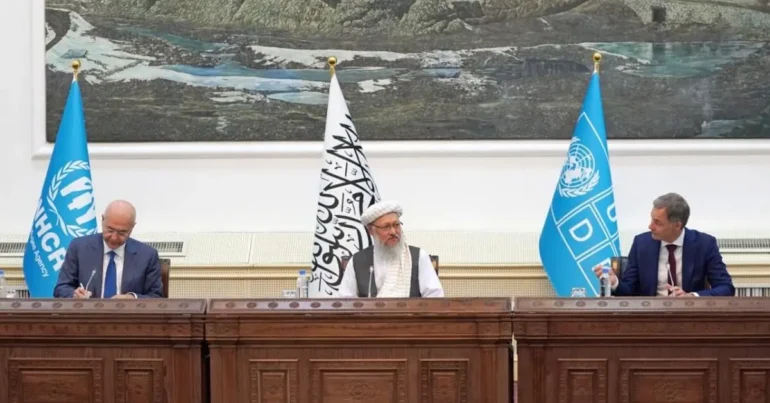

KABUL, AFGHANISTAN – Barham Salih, the United Nations High Commissioner for Refugees, and Alexander De Croo, head of the United Nations Development Programme, met with Abdul Salam Hanafi, the Taliban’s Deputy Prime Minister for Administrative Affairs, during their visit to Afghanistan.
According to a statement issued by the Taliban’s Office of the Prime Minister, during the meeting, held on (Tuesday, July 7), the UN High Commissioner for Refugees called on the Taliban to cooperate with humanitarian organizations.
Barham Salih also said that the humanitarian assistance provided by the United Nations High Commissioner for Refugees (UNHCR) to the people of Afghanistan will continue, and that the agency will spare no effort to support and facilitate their reintegration.
Alexander De Croo, head of the United Nations Development Programme (UNDP), also said that the organization and its partner agencies are prepared to cooperate with the Taliban in strengthening the economy and local trade, building infrastructure, and developing agriculture and irrigation in Afghanistan.
Abdul Salam Hanafi, for his part, said during the meeting that the people of Afghanistan, after several decades of war, are in need of support and assistance.
He described the deportation of Afghan migrants from neighboring countries as contrary to international law and the principles of good neighborly relations, adding that greater attention should be given to returning migrants so that they are not forced to migrate again.
The two senior UN officials arrived in Afghanistan three days ago to assess the humanitarian situation and the delivery of aid.
In addition to meeting with Taliban officials, they also traveled to several provinces, where they spoke with local residents and returning migrants.
A day earlier, the two senior UN officials stressed that Afghanistan cannot recover from its deepening humanitarian crisis without the full participation of women. Speaking during a visit to a carpet-weaving center in Nahr-e-Shahi district of Balkh province, they urged the Taliban to lift restrictions on women’s education and employment, emphasizing that the country’s recovery and development require the talents and contributions of both women and men.
The Taliban have imposed extensive restrictions on women since regaining power in 2021, including barring girls from secondary and higher education, prohibiting women from many jobs in government and NGOs, requiring a male guardian for long-distance travel, and banning them from public parks and other spaces.
In September 2025, the authorities extended the measures by banning Afghan women from working in UN offices, a decision that has drawn repeated condemnation from the world body.
Despite numerous appeals from the UN and international partners, the Taliban have shown no indication of reversing these policies.
The senior UN officials are visiting Afghanistan at a time when Taliban restrictions have intensified and the humanitarian situation has worsened.
Afghanistan has experienced a sharp increase in returns since late 2023 as Pakistan and Iran have intensified enforcement against undocumented Afghan migrants. UN figures indicate that more than 5.4 million Afghans have returned or been deported from the two countries combined since October 2023, with around 2.9 million in 2025 alone.
The rise in returns comes as Afghanistan faces a worsening humanitarian situation. UN estimates nearly 22 million people, close to half the population, require humanitarian assistance this year, while around 4 million children are suffering from acute malnutrition.
The United Nations has requested $1.71 billion to assist these people, but so far only 16 percent of the required funding has been secured.
In addition, clashes between Pakistani security forces and Taliban fighters, which reportedly began in late February 2025 and have continued intermittently for more than two months, have further worsened an already fragile humanitarian situation in Afghanistan.
The escalation in cross-border violence, along with the suspension of trade, transit, and land travel between the two countries for several months, has disrupted livelihoods, reduced access to essential goods, and increased economic pressure on ordinary people. As a result, humanitarian needs inside Afghanistan have grown further, deepening the reliance of vulnerable communities on international aid at a time when funding for relief operations remains insufficient.

