


KABUL, AFGHANISTAN – Pakistani authorities have intensified their crackdown on Afghan migrants in the northwestern province of Khyber Pakhtunkhwa, ordering the demolition of refugee homes, conducting widespread identity checks, and accelerating efforts to deport undocumented Afghans, according to residents, officials, and media reports.
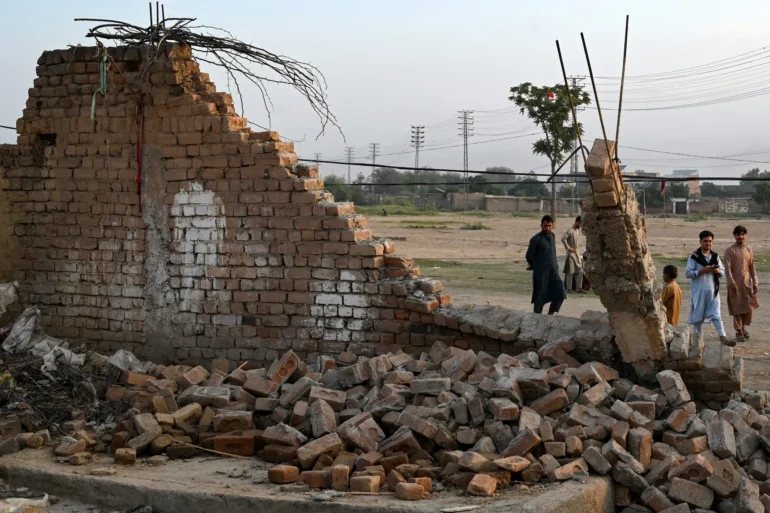
According to Agence France-Presse (AFP), authorities demolished numerous homes in the Afghan settlement of Mattani during July as part of a broader government campaign to repatriate Afghan nationals.
Community members and officials said the demolitions, identity document inspections, and eviction orders form part of Pakistan’s ongoing policy to remove undocumented migrants from the country.
Residents of Mattani, near the provincial capital of Peshawar, told AFP that authorities demolished many of the approximately 200 homes in the Afghan settlement during July.
Residents affected by the demolitions described being given little opportunity to recover their belongings. One resident, 50-year-old Najeeb Rehman, said officials did not allow him to retrieve essential items, including his father’s medication and his children’s school certificates, before his home was demolished.
“But the officers didn´t listen to us and just said to demolish the house,” he said, in the remains of the settlement where the walls of many homes were now in rubble.
The latest measures follow an order issued by Pakistan’s Interior Ministry in June directing police nationwide to begin arresting Afghan nationals without valid visas from July 10.
UN data showed almost 6,200 Afghans returned from Pakistan in the seven days to July 11, up by around a third from the previous week.
A senior police official in Peshawar, speaking on condition of anonymity, told AFP that a large-scale operation against undocumented Afghan nationals began on that date and remains ongoing.
“Even before the federal government issued clear directives, police had completed the mapping of Afghan nationals across all parts of the province,” the official said.
“The police don´t consider anyone´s circumstances. They don´t care whether I have any money in my pocket or not. They don´t take my health into account either,” said Ahmad Mula, 70, whose home in Mattani was demolished.
A journalist with AFP reported that temporary checkpoints have been established across Peshawar, where police are checking identity documents of passersby. One police officer said officers had received explicit instructions to detain undocumented Afghan nationals.
The crackdown has also affected businesses in Peshawar’s “Mini Kabul” market, where thousands of shops are operated by Afghan traders.
Shop owners reported a sharp decline in customers, with one merchant saying many Afghans were remaining inside their homes out of fear, bringing commercial activity to a standstill.
Pakistan launched a nationwide campaign to remove undocumented foreign nationals in October 2023, citing security concerns and the need to enforce immigration laws. The policy has primarily affected Afghan nationals, many of whom have lived in Pakistan for decades following successive conflicts in Afghanistan.
The repatriation drive has intensified amid strained relations between Islamabad and Afghanistan’s Taliban authorities, as well as growing security concerns in Khyber Pakhtunkhwa, a province that has witnessed a rise in militant attacks in recent years.
Pakistani officials say approximately 2.4 million Afghans have either returned voluntarily or been deported since the campaign began. According to data from the United Nations refugee agency (UNHCR), more than 1.15 million Afghans returned from Pakistan in 2025 alone.
The deportation campaign has drawn concern from United Nations agencies and human rights organizations, which have warned that many Afghans returning to their homeland face economic hardship, limited access to services, and potential protection risks.
Humanitarian agencies have called on Pakistan to ensure that returns are conducted on a voluntary basis, in safety, and in full compliance with international law, particularly for individuals with potential protection needs. They have also urged the international community to create more resettlement pathways and provide greater support for Afghans who remain displaced.

