

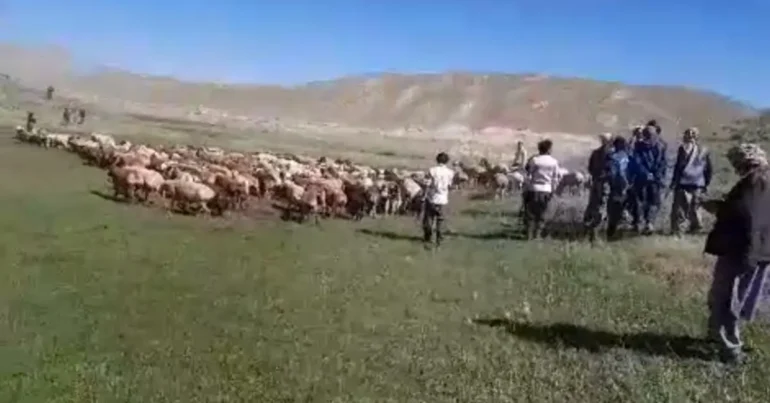

KABUL, AFGHANISTAN – Following the incursion of Kuchi herds into areas of Panjab district in Bamyan province, located in central Afghanistan, a delegation led by the Taliban governor has decided that, until a final decision is issued, no one is allowed to take their livestock into the disputed areas.
The Taliban’s Ministry of Interior announced today (Wednesday, July 1) that it had dispatched a delegation to resolve the dispute between Kuchis and local residents in Panjab district of Bamyan province.
The ministry said the delegation included local Taliban officials, among them Gul Haidar Shafaq, the governor; Habibullah Shakir, the police commander; Khalil-ur-Rahman Huzayfah, the intelligence chief; and Mohibullah Sajjad, the Taliban’s head of Borders and Tribal Affairs in the province.
According to the statement, after traveling to Panjab district, the delegation held a joint meeting with both sides to the dispute and emphasized the need for a “thorough assessment of the area.”
The Taliban delegation told both the Kuchis and local residents that “until a final decision is made, no one has the right to take their livestock into the disputed areas.”
The delegation pledged that the case would be resolved “in accordance with the rulings of Islamic Sharia and based on credible evidence and documentation.”
This comes as local residents complain that Kuchis have entered various parts of Hazarajat, including Bamyan, with herds numbering in the hundreds and thousands of livestock.
Local sources told KabulNow that over the past two weeks, Kuchis have entered several areas of Panjab district, including the villages of Qalacha Kerman, Karol, Pai Kotal Jamali, and Surkh Nowkar Dowlah, and have released around 25 herds onto the grazing lands of local residents.
Following complaints from local residents, the Kuchis reportedly said that the herds belong to Mullah Abdul Ghani Baradar, the Taliban’s Deputy Prime Minister for Economic Affairs, and that they have grazing authorization for these areas from Hibatullah Akhundzada, the Taliban’s supreme leader, and the group’s Ministry of Borders, Ethnicities and Tribes.
Residents of Bamyan say that the Kuchis who drive their herds onto local pastures and agricultural lands are armed and respond to any objections by opening fire and physically assaulting people.
On June 16, armed Kuchis released their herds onto the farmlands of local residents in the villages of Tobak and Poshta Gharghari in Panjab district. After residents protested, they reportedly beat three men—Mohammad Hussain, Jafar, and Ali Dad—“to the brink of death.”
Earlier, on June 6, armed Kuchis allegedly assaulted five men—Naeem, Mehdi, Habib, Ibrahim, and Haji Ishaq—in the village of Zarsang.
On June 17, the Taliban’s Ministry of Borders, Ethnicities and Tribes announced that a delegation composed of local Bamyan officials had resolved the problems between the Kuchis and local residents.
However, the renewed arrival of herds reportedly belonging to Mullah Baradar, accompanied by an audio recording in which the Kuchis claim authorization from the Taliban leader to graze in the area, has once again created tensions.
The Kuchis are traditionally nomadic pastoralist communities who move seasonally across different parts of Afghanistan in search of grazing land and water for their livestock. Their migrations have historically brought them into contact with settled farming communities, particularly in the central highlands.
Disputes over access to land, grazing rights, and natural resources have periodically led to tensions and conflicts between Kuchi groups and local residents, especially in predominantly Hazara areas.
Every year with the arrival of spring, Kuchis move with their livestock to the central regions of Afghanistan. Since the Taliban’s return to power, the influx of Kuchis into Hazara-populated areas has become a major source of tension and crisis.
In addition to the destruction of farmlands and grazing areas, local residents have faced harassment and violence by Kuchis. In recent years, several local residents have reportedly been killed by Kuchis.
Under successive governments before the Taliban’s return to power in 2021, Kuchi-settler disputes had remained unresolved but were often subject to mediated negotiation. The Taliban’s approach, however, has tipped the balance decisively in favor of the Kuchis, many of whom are ethnic Pashtuns with historic grazing routes across the country. Now, with Taliban courts consistently ruling in favor of nomads, Hazara residents say they have no legal recourse.

