

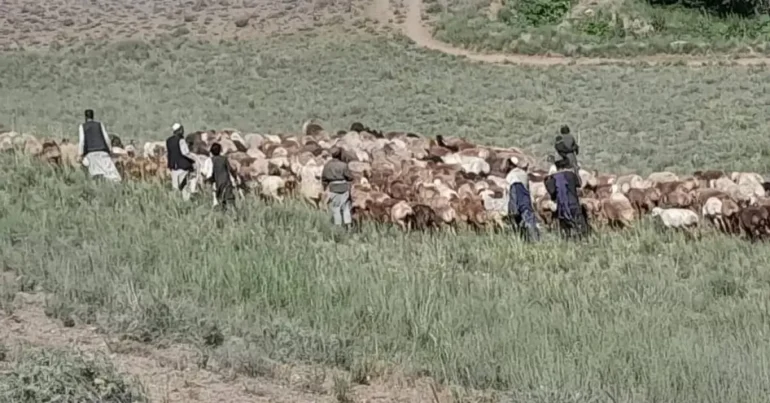

KABUL, AFGHANISTAN – Armed Kuchi Nomads Claim Flocks Belong to Taliban Deputy Prime Minister Abdul Ghani Baradar
Following the incursion of armed Kuchi nomads into the farmlands and grazing areas of residents in Panjab district of Bamyan province in central Afghanistan, local sources say the Kuchis claimed that the flocks belong to Abdul Ghani Baradar, the Taliban’s Deputy Prime Minister for Economic Affairs.
According to the sources, on Thursday (June 25), in the presence of a delegation that had traveled from the center of Bamyan to Panjab to investigate the issue, the Kuchis made this claim by playing an audio recording. The delegation included the Taliban’s deputy governor, deputy police chief, a representative of the intelligence directorate, and a representative of the Directorate of Tribes and Ethnic Affairs in Bamyan.
Sources also say that Kuchi women severely beat a Taliban intelligence member from Panjab who was accompanying the delegation in the Kotal Akhzarat area. He is currently receiving treatment at a local health center.
According to the sources, following the delegation’s visit, the Kuchis left the Qalacha Kerman area of Panjab district on Friday (June 26) and have now reached the vicinity of Saray Zard Sang in Panjab.
The sources said the Kuchis’ destination is the Behsud districts of Maidan Wardak province. However, along the way they have been damaging the farmlands and grazing areas of villages in Panjab district and harassing local residents.
According to the sources, local Taliban authorities in Bamyan have advised residents to avoid confrontations and conflicts with the Kuchis so that they can pass through the area and continue to their final destination.
Armed Kuchi nomads have raided several villages in Panjab district of Bamyan multiple times during the current solar year, releasing their flocks onto the farmlands and grazing areas of local residents. When confronted by villagers, they have reportedly beaten and threatened them.
Earlier this month, after raiding several villages in Panjab district, the Kuchis claimed that they had a “grazing order” from Hibatullah Akhundzada, the Taliban leader. They said he had instructed them that “the pastures of Hazarajat are ‘state property’ and belong to the government. Go and graze your flocks.”
The latest incident follows a series of similar confrontations in Panjab district. About two weeks ago, armed Kuchi nomads attacked residents of Tobak village in the Pashta Gharghari area after villagers tried to prevent their livestock from grazing on local farmland. According to local sources, at least three farmers were severely beaten and injured, with one reported to be in critical condition after the assailants allegedly opened fire and assaulted the villagers.
Kuchis are traditionally nomadic and semi-nomadic pastoralist communities in Afghanistan, the majority of whom belong to Pashtun tribes and migrate seasonally with their livestock in search of grazing land. For decades, disputes have arisen between some Kuchi groups and settled communities in central Afghanistan over access to pastures and land ownership.
These tensions have occasionally turned violent, particularly when armed Kuchi groups move their livestock onto cultivated farmland or disputed grazing areas and local residents attempt to prevent them. Human rights organizations and local communities have documented repeated incidents in which armed Kuchi groups allegedly assaulted civilians, destroyed crops, and damaged pastures, while Kuchis have at times argued that they are exercising historical grazing rights. The conflict remains one of Afghanistan’s longest-running land and ethnic disputes, with successive governments facing criticism for failing to resolve it peacefully.
In addition to damaging farmlands and pastures in central Afghanistan, Kuchi nomads have also reportedly killed several local residents over the years.
Much of central Afghanistan—including Bamyan, parts of Maidan Wardak, Ghazni, Daykundi, Ghor, and Uruzgan—is home to large Hazara communities. The region has long been the site of recurring disputes between local residents and Kuchi nomads over land ownership and seasonal grazing rights. These tensions have deep historical roots, dating back to the late nineteenth century, when many Hazaras were forcibly displaced from their lands during the rule of Amir Abdur Rahman Khan and grazing privileges were granted to some Kuchi tribes.
Hazara communities and human rights organizations have repeatedly argued that these historical injustices, combined with longstanding ethnic and religious discrimination, continue to fuel conflicts. Local residents have also accused armed Kuchi groups of attacking civilians, damaging farmland and pastures, and using violence or intimidation during seasonal migrations.
Since the Taliban returned to power in 2021, residents and rights advocates say such incidents have become more frequent, raising concerns about the safety of Hazara communities and the lack of accountability for abuses.

