

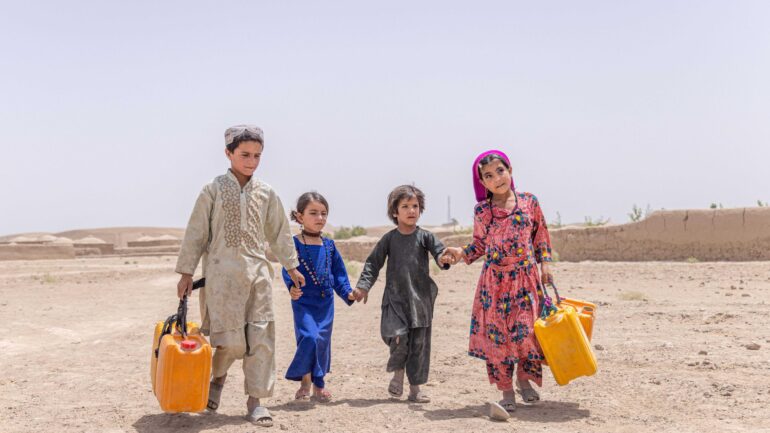

KABUL, AFGHANISTAN – Afghanistan is struggling with intensifying climate and environmental challenges that are deepening water shortages and threatening livelihoods, food security, and stability across the country, the United Nations said on Friday.
In a report marking World Environment Day, the United Nations Assistance Mission in Afghanistan (UNAMA) said prolonged drought, declining water resources, flooding, and environmental degradation are placing a growing strain on communities already affected by poverty and economic hardship.
More than half of Afghanistan’s population is affected by water scarcity, with prolonged droughts severely impacting agriculture, the mainstay of rural livelihoods, the mission said. Repeated crop failures have been reported in several regions, while shrinking water supplies are increasing competition over land and water resources.
“Our river has become unpredictable,” a farmer in Goshta district of Nangarhar Province was quoted as saying. “Last year, it dried when we needed it most; this year it flooded and destroyed half of our crops.”
The situation is particularly acute in southern provinces, including Kandahar, Helmand, Nimroz, Zabul, and Uruzgan, where recurrent drought, reduced rainfall, and unregulated groundwater extraction have strained water systems. Rivers are drying up, traditional irrigation systems have collapsed, and communities are drilling deeper wells, often unsuccessfully, UNAMA said.
Consequences include declining agricultural output, reduced access to safe drinking water and displacement of families in search of resources. Competition over scarce water and land has also heightened tensions in some areas.
In western provinces such as Ghor and Farah, prolonged drought prevails, while other areas face heavy rainfall and flash floods that destroy homes, farmland, and infrastructure. Flooding has worsened in central and eastern provinces, including Logar, Parwan, and Kapisa. Strong winds and dust storms in the south have damaged crops and contributed to respiratory illnesses.
Urban areas are also under strain. Air pollution in Kabul remains a significant public health issue during winter, linked to low-quality fuels and poor waste management. Growing tourism in areas such as Panjshir, Kapisa, and Maidan Wardak has increased waste in rivers and valleys.
UNAMA noted some resilience efforts, including the Qosh Tepa Canal project, which aims to divert water from the Amu Darya River to expand irrigation in northern provinces. Community-led initiatives include planting drought-resistant vegetation to stabilize dunes and riverbanks, along with improved irrigation and water-retention techniques.
The mission said it has supported climate awareness and environmental protection by engaging local authorities, institutions, journalists, and community leaders.
“As climate pressures intensify, coordinated action remains critical to building resilience and protecting Afghanistan’s natural resources,” UNAMA said.
Afghanistan contributes just 0.08% of global greenhouse gas emissions but is among the world’s most climate-vulnerable nations. It faces one of the most severe water shortages, driven by years of drought, weak infrastructure, and climate change impacts. Experts have warned that Kabul, home to more than five million people, could become the first modern capital to run out of water by 2030 as its aquifers continue to decline.

