

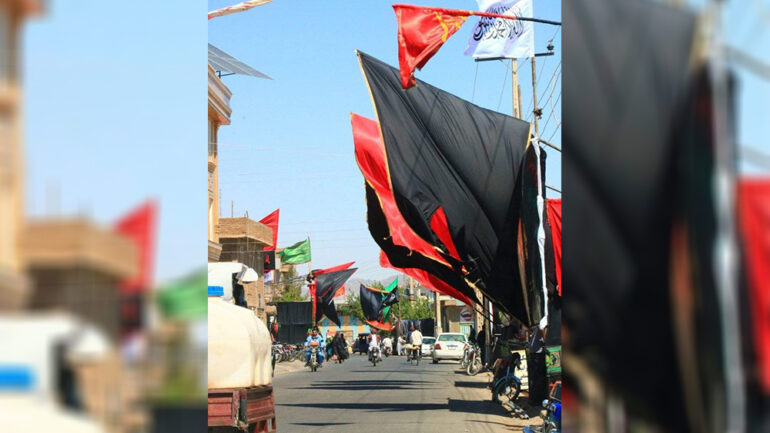

KABUL, AFGHANISTAN – As the month of Muharram approaches, the Afghanistan Shia Ulema Council has stated in a declaration that it expects the Taliban security authorities to provide the conditions necessary for the safe observance of Muharram and Ashura mourning ceremonies.
The statement, published today (Monday, June 15), says that the Taliban should “take into consideration the religious and sectarian rights of all citizens.”
In recent years, the Taliban have imposed restrictions on Shia mourning ceremonies during the first ten days of Muharram.
These ceremonies have also faced security threats in previous years and have repeatedly been targeted in deadly attacks. Attacks against Shia communities in Afghanistan have largely been claimed by ISIS.
The Afghanistan Shia Ulema Council stated that it expects security officials to ensure that Muharram and Ashura commemorations can be held safely and respectfully, while also safeguarding the religious and sectarian rights of all citizens.
The council also called on the organizers of mourning processions and gatherings to fully cooperate with Taliban authorities and security forces “in ensuring the security of the ceremonies so that mourning events can be held in a peaceful and secure environment and without restrictions.”
The Afghanistan Shia Ulema Council further stated that speakers at mourning ceremonies should refrain from “any subject or statement that may cause division among the Muslim residents of the country.”
The council called on religious leaders and reciters to responsibly convey the true message of Ashura to younger generations, emphasizing justice, accountability, and Islamic values, and to avoid statements that might undermine unity among the country’s Muslim population.
Over the past five years, the Taliban have imposed severe restrictions on Shia communities.
The group has removed official recognition of the Ja’fari school of jurisprudence, the Shia Personal Status Law, and Ja’fari jurisprudence subjects from Afghanistan’s educational system.
In the current solar year, Shia students at some universities have reportedly been required to sign a pledge of “adherence to the Hanafi school of thought” in order to continue their studies.
Before the Taliban’s return to power in August 2021, Shia communities in Afghanistan observed Muharram rituals openly. Since then, the group has imposed widespread restrictions on Shia religious practices.
Two years ago, the Taliban banned public Muharram ceremonies in major cities including Kabul, Herat, Ghazni, and Mazar-e-Sharif. Roadside refreshment stalls, processions, and the public recitation of elegies, even on public transport, were prohibited.
In one of the deadliest incidents, Taliban forces opened fire on Ashura mourners in Ghazni in 2023, killing four and injuring at least 33 others.
In Mazar-e-Sharif, authorities prevented Shia mourners from gathering at the shrine of Ali, a vast religious complex in the city center that traditionally draws large crowds during Muharram.
Residents say the restrictions are not limited to urban centers. In some remote areas, where there are no apparent security threats, Muharram observances have also been curtailed.
Muharram is the first month of the Islamic calendar, and its tenth day, known as Ashura, holds special significance for Muslims. For Shia Muslims, Ashura commemorates the martyrdom of Imam Hussein, the grandson of Prophet Muhammad, who was killed along with his companions in the Battle of Karbala in 680 CE.
The event is observed through mourning ceremonies, processions, and religious gatherings. Afghanistan is home to both Sunni and Shia Muslims. Most Sunnis follow the Hanafi school of Islamic jurisprudence, while most Shias adhere to the Ja’fari school of thought, which derives its teachings from Imam Ja’far al-Sadiq. Both schools share the core beliefs of Islam but differ in certain religious and legal interpretations and practices.
The statement comes as concerns continue to grow among Afghanistan’s Shia community regarding religious freedoms, equal access to education, and the ability to openly practice their faith under Taliban rule. Human rights organizations and community representatives have repeatedly called for the protection of religious minorities and the safeguarding of their rights in accordance with international human rights standards.
Afghanistan’s Shia community, the majority of whom follow the Ja’fari school of thought and belong to the Hazara ethnic group, has faced decades of security threats, discrimination, and sectarian violence. In recent years, mosques, educational centers, schools, and public gatherings attended by Shias have been targeted in a series of deadly attacks, many of which were claimed by ISIS-K.
Human rights organizations have repeatedly expressed concern about the vulnerability of Shia communities, particularly during major religious events such as Muharram and Ashura, when large public gatherings can become targets for extremist groups. Community leaders have frequently called on Afghan authorities to ensure adequate security measures and protect the religious freedoms of Shia Muslims.

