

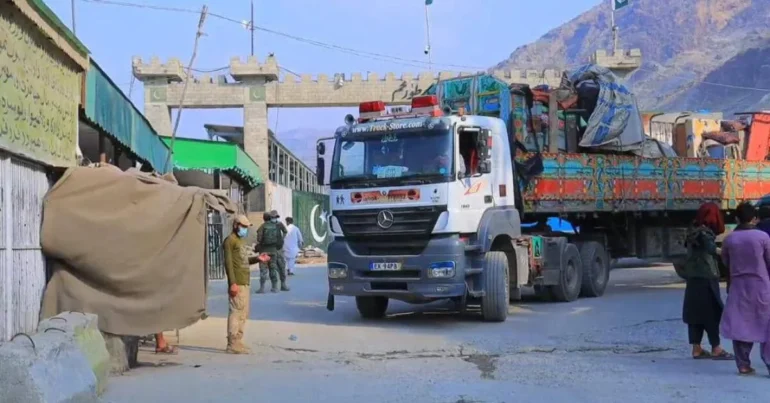

KABUL, AFGHANISTAN – The economic publication Business Recorder has reported that tensions between Pakistan and the Taliban authorities in Afghanistan, along with the Middle East crisis, have delivered “two major shocks” to Pakistan’s economy, causing the country to incur losses of $1.4 billion over the past seven months.
In a report published today (Wednesday, June 3), the outlet, citing a report by Pakistan’s Ministry of Commerce titled “Impact of Iran & Afghanistan Conflicts on Pakistan’s International Trade,” stated that Pakistan has suffered losses of $850 million due to the closure of its border crossings with Afghanistan during the past seven months (from October 11, 2025, to May 18, 2026).
Pakistani transport companies earn an average of $200 million annually from Afghanistan and the transit of passenger vehicles. This revenue stream has been halted following the closure of the border crossings between the two countries. Afghanistan is now seeking to transit passenger vehicles through Iranian corridors.
In addition, the U.S. and Israeli war with Iran, which has affected the entire Middle East, has inflicted a $600 million blow to Pakistan’s export economy in the Gulf states.
Business Recorder said that the U.S. and Israeli war with Iran has not only affected the Middle East but has also contributed to a global economic crisis.
Although Pakistan’s trade volume over the past nine months has reached $28 billion, it represents a 23 percent decline compared to the same period a year earlier.
The conflict between Pakistan and the Taliban authorities in Afghanistan began over disagreements regarding the presence of Tehreek-e-Taliban Pakistan (TTP) forces on Afghan soil. It initially started as a border dispute and later escalated into a full-scale war between the Taliban authorities and the Pakistani government.
Pakistan launched attacks on various Afghan cities, while the Taliban, in addition to attacking Pakistani border posts, closed the Torkham, Spin Boldak, and Bahramcha crossings and banned trade with Pakistan, a measure that remains in effect.
Pakistan’s exports to Afghanistan have now come to a halt, and the Taliban authorities have instructed traders to stop importing goods purchased from China, India, and other countries through Pakistan. Instead, they have been directed to use alternative routes such as Iran’s Chabahar Port and the China–Central Asia railway corridors.
The value of trade between Afghanistan and Pakistan reached $2.461 billion in 2024, but declined to $1.766 billion in 2025.
According to statistics from the Taliban Ministry of Commerce, Afghanistan’s exports to Pakistan amounted to approximately $817 million in 2024, but fell to $505 million in 2025.
The ministry also stated that Afghanistan imported goods worth $1.644 billion from Pakistan in 2024, a figure that dropped to $1.261 billion in 2025.
With the complete closure of border crossings between Afghanistan and Pakistan, trade between the two countries appears to have come to a standstill in recent months.
The two countries share several major trade routes that are vital for the movement of food, fuel, and consumer goods, particularly for landlocked Afghanistan.
The prolonged closure has disrupted supply chains, causing significant losses for traders on both sides and driving up prices in local markets. Afghan traders previously reported daily losses of at least $2.5 million, while Pakistani media cited export and import losses of $45 million and $59 million, respectively, as of early November.
Earlier, traders from both countries agreed to establish a joint committee to explore ways to reopen the borders. Pakistan’s foreign ministry, however, has said crossings will remain closed until the Taliban provide written assurances to prevent militant attacks and take action against the Pakistani Taliban, also known as TTP.
The sharp decline in bilateral trade highlights the broader economic consequences of prolonged political and security tensions between neighboring countries. Analysts note that the disruption of traditional trade routes is accelerating Afghanistan’s efforts to diversify its transit and trade partnerships, while businesses and transport sectors on both sides of the border continue to bear significant financial losses.

