

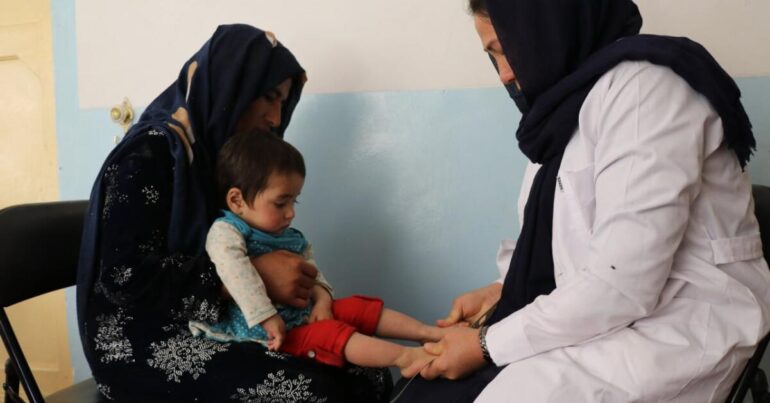

KABUL, AFGHANISTAN – The United Nations Office for the Coordination of Humanitarian Affairs (OCHA) says that although Afghanistan has one of the highest maternal mortality rates in the world, the Taliban have still restricted mothers’ and newborns’ access to life-saving services.
In a message posted on X today (Monday, June 1), OCHA said that mothers and newborns must have access to life-saving services.
The organization stated: “Skilled care & women health workers save lives, but restrictions on women’s participation are limiting access to life-saving services for mothers and newborns.”
OCHA said that Afghanistan has one of the highest maternal mortality rates in the world.
According to the organization’s statistics, around 600 women out of every 100,000 die during childbirth.
Since regaining control of Afghanistan, the Taliban have imposed widespread restrictions on fundamental freedoms and women’s rights. The group has even banned women from studying in medical institutes and has instructed healthcare centers in some provinces not to treat women without a male guardian.
Additionally, (OCHA) earlier reported that mental health and psychosocial support (MHPSS) activities in Afghanistan had been banned, as restrictions on women and humanitarian access had intensified across the country.
The agency noted that women, who were heavily reliant on these community-based services, were disproportionately affected by their suspension, further limiting their access to essential support.
Among these restrictions, the Taliban have prohibited women from visiting health centers without a male guardian and have also banned male doctors from examining female patients. These restrictions are enforced in most parts of the country, particularly in government health facilities.
UN experts, international rights groups, and activists have described the Taliban’s systematic oppression of women as “gender apartheid,” an institutionalized system that subjugates women solely because of their gender. Despite international pressure, including from Muslim-majority countries and global organizations, the Taliban have refused to reverse the restrictions, leaving millions uncertain about their future.
The UN and rights groups emphasize that Afghanistan’s development and prosperity are closely tied to women’s participation in education, work, and public life. Restricting these opportunities not only violates basic human rights but also hampers economic growth, innovation, and the country’s ability to recover from decades of conflict.
These ongoing restrictions not only undermine the basic human rights of women and girls but also pose a significant threat to the overall public health system in Afghanistan, increasing the risk of preventable illnesses, maternal mortality, and long-term health crises across the country.

