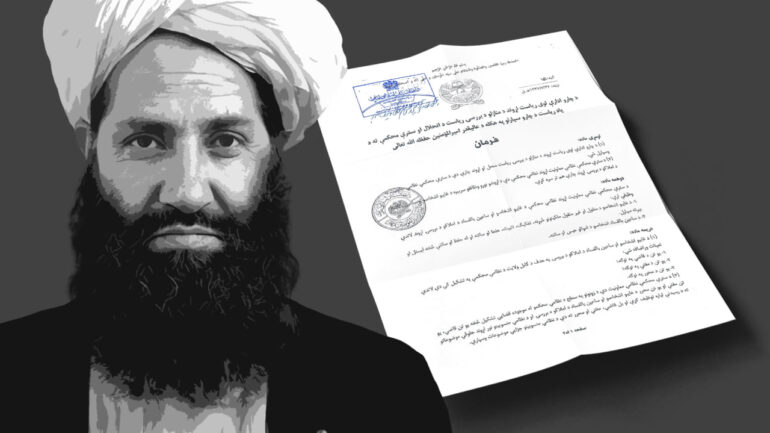

KABUL, AFGHANISTAN – The Taliban have introduced a new law giving their supreme leader, Hibatullah Akhundzada, final authority over the return of assets belonging to individuals the group designates as opponents of its rule.
The legislation, published in the Taliban’s official gazette as the “Law on the Review of Movable and Immovable Property of Absent Persons,” sets out procedures for identifying, managing, and returning property of people who are absent or missing.
Under the law, assets of ordinary absent owners may be returned to them, their heirs, or legal representatives through a judicial order. However, property belonging to those classified as “sa’een bil-fasad” can only be transferred with the explicit approval of Akhundzada.
The law defines “sa’een bil-fasad” as people who “continue to oppose the Taliban administration, seek to spread division and corruption, or support individuals deemed corrupt by the authorities.”
An “absent person” is defined as someone, or whose legal representative, who is unable to access property, while a “missing person” is someone whose whereabouts and status, whether alive or dead, remain unknown.
The legislation establishes a dedicated department under the military deputy of the Taliban Supreme Court to oversee implementation. The office is responsible for identifying, registering, protecting, and managing the assets of absent individuals, as well as collecting any income generated from them.
The department is also authorized to coordinate with several Taliban institutions, including the General Directorate of Intelligence, Kabul municipality, the state land authority, and Da Afghanistan Bank, to verify ownership records and manage property-related data.
Article 29 of the law requires the department to return private homes that were seized by individuals or official and unofficial bodies, either before or after the Taliban’s return to power in 2021, to their rightful owners or legal representatives following a court ruling.
The legislation also states that property belonging to deceased individuals who leave no heirs or legal claimants will be transferred to the public treasury.
The law comes more than four years after the Taliban returned to power in August 2021. Since then, thousands of Afghans, including former government officials, politicians, security personnel, and anti-Taliban figures who left the country, continue to own homes, land, businesses, and other assets in Afghanistan.
Taliban authorities say the law is intended to regulate and protect the assets of absent or missing persons and prevent disputes over ownership. However, critics say the broad definition of “sa’een bil-fasad” could give authorities wide discretion in deciding who is classified as an opponent and whether their assets are returned or withheld.
The decree also comes amid longstanding disputes over land and property ownership. Residents, former officials and rights groups have reported cases that Taliban members have seized or occupied private property, particularly land and homes belonging to former government figures and other citizens.