

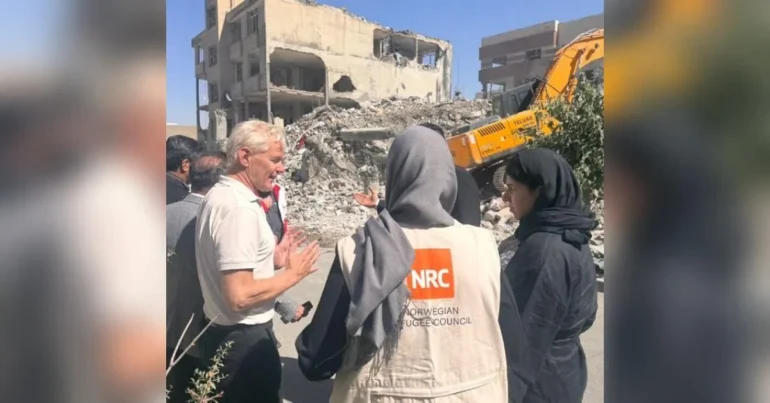

KABUL, AFGHANISTAN – Millions of Afghan refugees in Iran are facing deteriorating humanitarian conditions due to conflict-related disruption, economic pressure, and a severe funding shortfall, the head of the Norwegian Refugee Council (NRC) has said.
Jan Egeland, who leads NRC, said in a post on X following a recent visit to Iran that Afghan refugees and vulnerable Iranian families are both affected by ongoing conflict and economic instability.
He said widespread US and Israeli airstrikes led to large-scale displacement, forcing civilians to flee affected areas. Children have suffered psychological trauma and interruptions to schooling, while families are struggling with inflation, job losses, and rising living costs.
“Families here in Iran, both vulnerable Iranians and Afghan refugees, are paying a terrible price for this war,” Egeland wrote, adding that fear of renewed escalation remains widespread among those he met.
Egeland said more than four million Afghans are currently living in Iran, and urged stronger international support, warning that existing funding is insufficient to maintain humanitarian operations at scale.
He also pointed to an increase in returns to Afghanistan, saying rising economic and social pressures have driven more Afghans to leave Iran. He warned that Afghanistan lacks adequate infrastructure, services, and employment opportunities to absorb large numbers of returnees.
The NRC chief said the organization and its partners are continuing assistance programs for displaced Afghan and Iranian families, but are operating with only about one-third of the funding required for emergency response.
“Without further funding, we will have to reduce our emergency relief efforts instead of scaling up for those in desperate need,” he added.
Iran hosts one of the world’s largest Afghan populations, including refugees, migrant workers, and undocumented residents, many of whom have lived in the country for years. Aid agencies estimate that tens of thousands have returned to Afghanistan since the start of the conflict, while more than one million others remain at risk of deportation amid the ongoing crackdown.
Aid groups have repeatedly warned that Afghanistan is already facing severe economic challenges, high unemployment, and widespread humanitarian needs. They say a sharp increase in returnees could further strain limited services in housing, healthcare, education, and livelihoods, particularly in already vulnerable urban and border areas.
They continue to call for sustained international funding, saying long-term support is needed not only for refugees in host countries like Iran but also for reintegration efforts in Afghanistan.

