

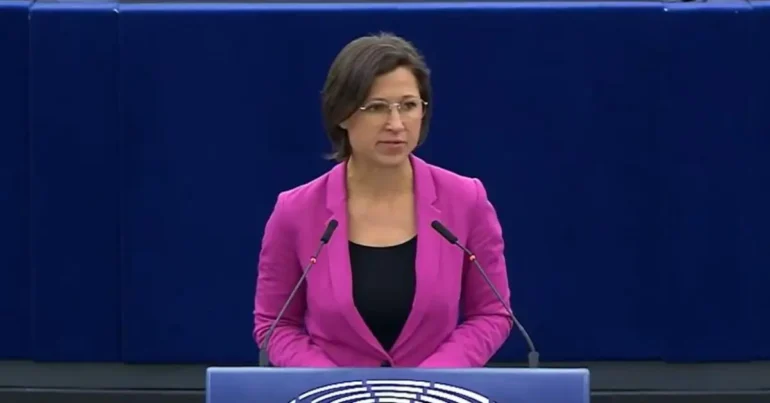

KABUL, AFGHANISTAN – Hannah Neumann, a Member of the European Parliament, has strongly criticized the invitation extended to a Taliban delegation to Brussels, saying that the move puts Europe’s credibility and security at risk.
In an interview with Euractiv published on Friday (June 5), Neumann sharply criticized the European Union’s engagement with the Taliban.
She said that these relations are being justified as “technical cooperation to facilitate deportations,” while millions of girls in Afghanistan remain deprived of their right to attend school because of Taliban restrictions.
The European lawmaker said that focusing on deportation agreements instead of core foreign policy values weakens both a country’s credibility and its security.
She also said it is very contradictory for European governments to allow Taliban officials to travel in Europe while millions of Afghan girls are still denied education under Taliban rule.
According to her, the damage caused by this decision extends beyond Afghanistan, because “if Europe gives in this easily under pressure, other authoritarian regimes will draw their own conclusions.”
Two weeks ago, the European Commission announced, without specifying a date, that a Taliban delegation would travel to Brussels for technical talks.
While the EU does not formally recognize the Taliban administration, the reported invitation has triggered sharp criticism from human rights organizations, United Nations experts, Afghan activists, and several members of the European Parliament. Critics argue that even limited or technical engagement could amount to indirect political legitimization of Taliban rule and undermine EU human rights principles.
The European Commission says that no senior diplomats from either side will participate in these meetings and that the discussions will remain strictly technical in nature in order to facilitate the deportation process for migrants.
However, it does not appear that the Taliban are approaching these talks with the same intentions. The Afghan diaspora has expressed serious concerns about its security following the presence of Taliban members in European countries, voicing these concerns through several protest events.
Over the past two years, several EU countries — including Germany, Austria, Switzerland, Norway, and the Netherlands — have held meetings with Taliban delegations, often justified as necessary to facilitate the deportation of Afghan migrants. Germany has conducted multiple chartered deportation flights to Kabul in recent months, sending back dozens of Afghans convicted of crimes.
Germany was among the first European countries to engage with the Taliban and accepted two Taliban diplomats at the Afghan Embassy in Berlin and the Afghan Consulate in Bonn as “technical staff” to help facilitate deportations.
Reports have now emerged suggesting that these two Taliban representatives not only control Afghanistan’s embassy and consulate but also prevented a deportation flight from taking off last week in an attempt to “blackmail” Germany.
According to a report by NDR, the Taliban Ministry of Foreign Affairs, through its representatives, informed the German government that it must accept more diplomats appointed by the Taliban; otherwise, flights carrying deported migrants to Kabul would no longer be permitted.
Moreover, Neumann has previously criticized European deportation policies toward Afghan asylum seekers. In a statement published last month, she described deportations to Afghanistan as both a humanitarian failure and a strategic mistake, arguing that returning young Afghan men to conditions of poverty and hopelessness could drive them toward Taliban-linked networks and religious schools that provide basic support and a sense of belonging.
According to Neumann, such policies risk reinforcing, rather than weakening, the Taliban’s system of dependency, social control, and loyalty. Her latest criticism of the EU’s engagement with the Taliban therefore reflects broader concerns about policies that, in her view, may inadvertently strengthen the group’s hold on power.
UN Special Rapporteur on human rights in Afghanistan Richard Bennett expressed concern that returns could violate the principle of non-refoulement, citing widespread abuses under Taliban rule, especially against women, journalists, human rights defenders, and former government officials.
Aid groups highlighted the dire conditions awaiting returnees. “Deporting Afghans back to a country where almost half of the population cannot feed themselves is not a migration policy; it is a decision that could cost lives,” said Lisa Owen, the International Rescue Committee’s country director for Afghanistan.
UN agencies and rights groups have repeatedly voiced alarm over forced returns while Afghanistan faces one of its worst humanitarian crises under Taliban rule. Nearly half the population depends on foreign aid, with acute malnutrition rising among women and children, according to UN data.
Neighboring countries have already carried out large-scale deportations. Pakistan and Iran have collectively returned more than five million Afghans since late 2023, according to the UN. Many returnees face unemployment, displacement, and limited access to humanitarian support upon arrival.
The controversy surrounding the EU’s engagement with the Taliban highlights the growing tension between migration management objectives and broader commitments to human rights and democratic values. Critics argue that any form of official engagement with the Taliban risks legitimizing a regime that continues to impose severe restrictions on women and girls, while supporters maintain that practical cooperation is necessary to address migration and consular issues.

