

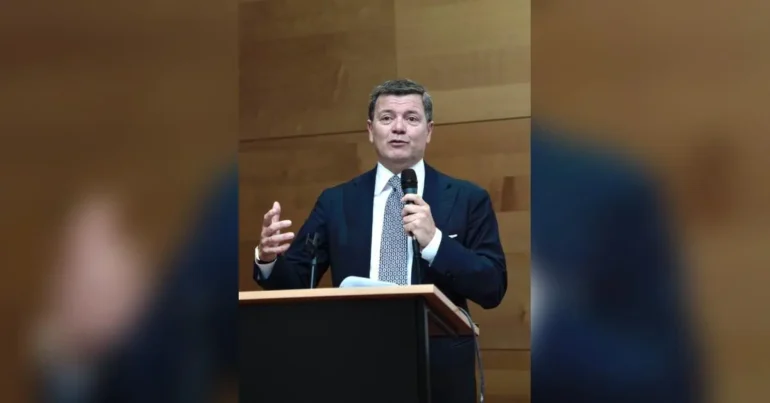

KABUL, AFGHANISTAN – The European Union has appointed Nicola Bellomo, an Italian diplomat, as the Chargé d’Affaires of its delegation to Afghanistan.
In a statement, the European External Action Service announced a list of new ambassadors and representatives of the European Union in several countries.
Nicola Bellomo, who currently serves as Head of Africa Affairs at the European External Action Service, previously held the position of EU Ambassador to the Republic of Rwanda.
Following the collapse of the Islamic Republic and the Taliban’s return to power, the European Union reduced the level of its relations with Kabul.
Instead of an ambassador, a Chargé d’Affaires is responsible for managing political relations and overseeing the implementation of European Union programs in Afghanistan.
At present, Ms. Veronika Bošković Pohar, a Slovenian diplomat, serves as Interim Chargé d’Affaires and heads the European Union Delegation in Afghanistan.
The appointment of a new Chargé d’Affaires reflects the European Union’s continued engagement in Afghanistan through diplomatic channels while maintaining its current level of representation.
The European Union has maintained a policy of “engagement without recognition” toward the Taliban since the group returned to power in August 2021. While the EU has not formally recognized the Taliban government, it has kept a diplomatic presence in Afghanistan through its delegation in Kabul and continues to engage with Taliban officials on issues such as humanitarian access, migration, security, and the delivery of assistance.
The EU has repeatedly stated that any normalization of relations depends on the Taliban’s behavior, particularly regarding human rights, the formation of an inclusive government, counterterrorism commitments, and respect for international obligations. The bloc has consistently condemned the Taliban’s restrictions on women and girls, describing them as a serious violation of fundamental rights and a major obstacle to deeper engagement.
Despite political tensions, the European Union remains one of Afghanistan’s largest humanitarian donors. Since 1994, the EU has provided more than €2 billion in humanitarian assistance to Afghanistan, and it continues to fund emergency food aid, healthcare, education, water and sanitation services through United Nations agencies and international humanitarian organizations rather than through Taliban institutions.
EU officials argue that supporting the Afghan population is essential to preventing further humanitarian deterioration, regional instability, irregular migration, and security threats.
At the same time, recent contacts between the EU and Taliban representatives, including discussions related to migration and deportation issues, have generated debate within Europe, with critics warning that increased engagement could be perceived as legitimizing a regime that continues to impose severe restrictions on women’s rights and political freedoms.

