

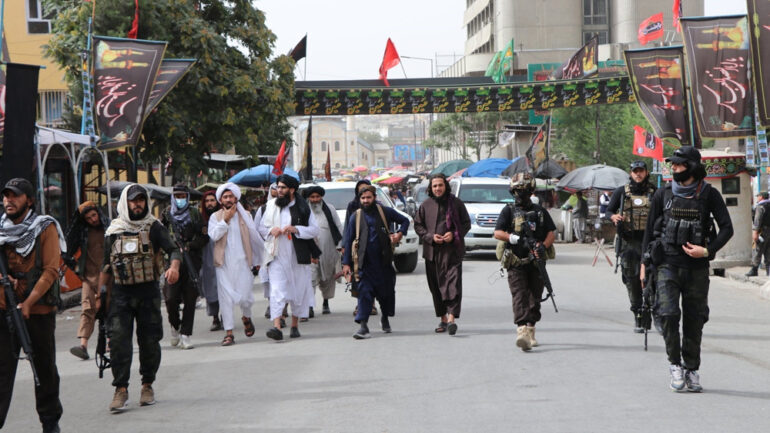

KABUL, AFGHANISTAN – Afghanistan’s Shia minority marked Ashura, the 10th day of Muharram, on Friday with mourning processions and gatherings held across the country under tight restrictions enforced by the Taliban authorities.
Thousands of mourners gathered in major cities, including Kabul, Kandahar, and Herat, to commemorate the martyrdom of Imam Hussein, the grandson of the Prophet Muhammad, and his companions in the Battle of Karbala in 680 CE.
In Kabul, ceremonies were held at Shia mosques and tekyehs, while in Herat’s Shia-majority areas, including Jebrael and Andisha Township, mourners took part in processions and chest-beating rituals. Similar gatherings were reported in Kandahar.
Local sources said Taliban authorities imposed measures similar to previous years, limiting ceremonies to designated venues, banning the display of Muharram flags and mourning symbols outside approved sites, and restricting the use of mosque loudspeakers beyond mosque compounds. Telecommunications services in parts of Kabul and several other provinces were also disrupted early on Friday, according to residents.
The Afghanistan Shia Ulema Council said in a statement issued ahead of Ashura that several mosque and tekyeh officials had been detained in recent days over the installation of mourning symbols. The council also said Taliban authorities had removed flags and symbols from some mosques and Hussainiyas, despite earlier understandings reached through a Taliban-appointed Muharram committee.
“These actions have caused widespread concern within the Shia community and require urgent attention from senior authorities,” the council said.
The council did not specify how many people had been detained. Afghanistan International reported that the Taliban justice minister had summoned several Shia elders, including Fakuri Beheshti, Hayatullah Alami, Sufi Gardizi, Sheikh Nateqi and Nematullah Ghafari, and held them for several hours on Tuesday before ordering the removal of mourning flags.
Separately, the Afghanistan Media Support Organization (AMSO) reported that Taliban authorities detained a female journalist in Kabul while she was covering Ashura ceremonies.
The media watchdog said the reporter and her colleagues were held at a Taliban district office in western Kabul and released later in the day after mediation by media officials and family members. AMSO said the journalist was subjected to “inappropriate, threatening, and intimidating” treatment over the presence of a “non-mahram cameraman.”
Ashura, which falls on the 10th day of Muharram, the first month of the Islamic calendar, is one of the most important religious occasions for Shia Muslims. Before the Taliban’s return to power in August 2021, Shia communities in Afghanistan were able to observe Muharram rituals more openly, including public sermons, roadside refreshment stalls for mourners, and processions.
Since taking control, the Taliban have progressively tightened rules on Shia practices. Public sermons in major cities such as Kabul, Herat, and Mazar-e-Sharif have been curtailed, while convoys and public recitations of elegies have been barred. In 2023, Taliban forces opened fire on Ashura mourners in Ghazni province, killing four people and wounding nearly 33 others.
A 2025 report by the United States Commission on International Religious Freedom said the Taliban had effectively “eradicated” religious freedom in Afghanistan by enforcing a single interpretation of Islam and targeting religious minorities. The commission urged the U.S. State Department to designate Afghanistan as a “country of particular concern” over systematic violations of religious freedom.

