

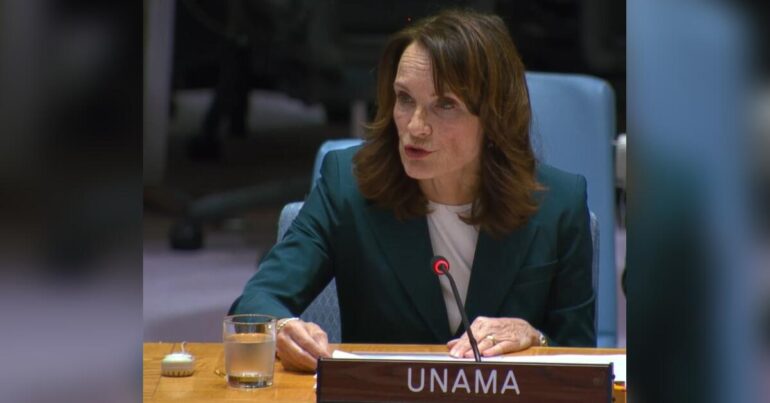

KABUL, AFGHANISTAN – Afghanistan appears stable under Taliban control but faces a precarious long-term future with no clear path forward, the acting head of the United Nations Assistance Mission in Afghanistan (UNAMA) told the UN Security Council on Monday.
Briefing the council, Georgette Gagnon said the Taliban have consolidated territorial and administrative control across the country and face no meaningful armed or political challenge.
“On the surface, Afghanistan under the de facto authorities remains stable. Territorial and administrative control has been consolidated and there is no meaningful armed or political challenge to their rule,” she said.
She cautioned, however, that longer-term scenarios depend largely on internal Taliban dynamics, particularly tensions between ideological policies that place severe burdens on the Afghan people and more pragmatic approaches that have helped sustain the system.
“For now, what exists is increasing control by the de facto authorities without a clear end-state,” she added.
Gagnon said she had recently travelled across Afghanistan and heard widespread concerns from communities about worsening humanitarian conditions, economic pressure, and shrinking rights.
She described the situation of women and girls as especially severe, warning of long-term consequences for Afghan society.
“What we are witnessing are severe and growing restrictions — the imposition of systemic and institutionalized harm with long-term generational consequences for Afghan society as a whole,” Gagnon said.
She said an estimated 3.8 million girls aged 7 to 18 are currently out of school, including more than 2.6 million adolescents, and that around 250,000 additional girls are excluded from secondary education each year.
Gagnon added that restrictions on women’s education and employment are already affecting the economy, citing a UNICEF analysis showing long-term damage to development prospects. She said sectors such as health and education could lose more than 25,000 female professionals by 2030, directly affecting service delivery and worsening maternal and child health outcomes.
On the humanitarian situation, she said Afghanistan remains one of the world’s largest crises, with around 21.9 million people expected to need assistance in 2026, nearly 45 percent of the population. She added that the crisis is being intensified by economic fragility and large-scale returns of Afghan migrants from neighboring countries.
“Afghanistan continues to experience one of the largest and most complex humanitarian crises in the world,” she said, noting that the absence of a clear political future further increases uncertainty.
Gagnon called on the Taliban to lift all restrictions on women and girls, describing them as violations of the UN Charter and fundamental human rights commitments. “The solution is clear: the ruling authorities must lift the restrictions imposed on the education and employment of women and girls. This action would benefit all Afghans.”
Gagnon stressed that engagement with the Taliban does not constitute endorsement of the regime but is necessary for situational awareness, facilitating dialogue and supporting the Afghan people.
Speaking at the session, OCHA Crisis Response Division Director Edem Wosornu warned that humanitarian operations are under severe strain due to funding gaps and restrictions on female aid workers, reducing the effectiveness of aid delivery, particularly for women and girls.
“In the absence of women in humanitarian operations, a large portion of women and girls in need are left without services,” Wosornu said, adding that 4.7 million people face acute food insecurity and 3.7 million children suffer from severe malnutrition. She also said only 15% of the $1.71 billion required for humanitarian response has been funded.
Human rights activist Metra Mehran criticized international engagement with the Taliban, arguing it has emboldened the group. She said the Taliban has issued over 230 decrees since regaining power, criminalizing even women’s “voice and face” and institutionalizing repression through measures like the “Law on the Promotion of Virtue and Prevention of Vice” and “Regulation on the Separation of Spouses.”
Mehran labeled the Taliban policies as “gender apartheid” and said they lie “at the center of their governance model.” She criticized the UN led Doha Process for sidelining women and civil society, eroding its legitimacy, and urged the Council and UNAMA to avoid any engagement that normalizes Taliban repression. Mehran called for full, meaningful participation of Afghan women in all processes and emergency protection pathways for at-risk women, alongside an end to forced returns.
She also called on the international community to avoid normalization of relations with the Taliban and urged stronger accountability mechanisms, including international legal action, to address human rights violations.

