

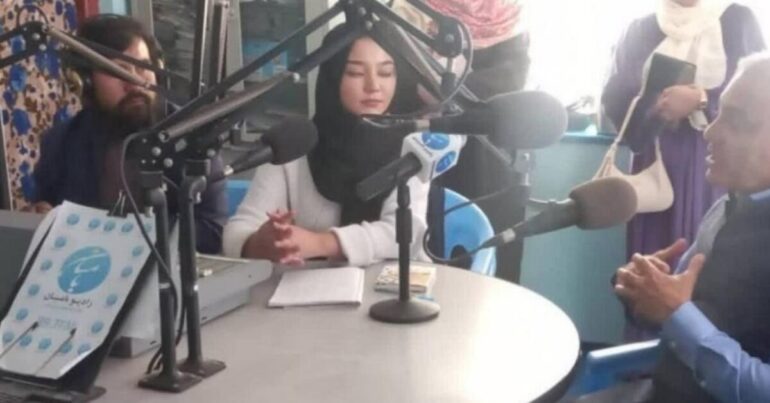

KABUL, AFGHANISTAN – The Afghanistan Journalists Center (AFJC) has strongly condemned the Taliban’s “arbitrary” closure of Bamyan Radio, a private station in central Afghanistan, and called for its immediate reopening and the renewal of its operating license.
The Taliban intelligence directorate in Bamyan suspended the station’s broadcasts on May 17 and sealed its office without prior notice, according to the AFJC. Bamyan Radio, established in 2003, is the province’s first private radio station and has long broadcast news, cultural, educational, social, economic, and political programming to local audiences.
The Taliban have so far given no official reason for shutting down the station. However, the AFJC, citing its sources, said that the station was shut because its operating license had not been renewed, despite repeated applications submitted by its management in recent months
The media watchdog described the move as a serious violation of press freedom and the public’s right to information. It called on the Taliban to immediately reverse the decision, renew the license without further delay, and allow the station to resume operations without any condition.
Following the closure, only one private radio station, Nasim, remains operational in Bamyan province, significantly diminishing media diversity and local access to independent news and information.
The AFJC said the incident is part of a broader pattern of increasing censorship and suppression of media under Taliban rule. Between March 2025 and March 2026, the group documented at least 207 violations against journalists’ rights across Afghanistan.
According to the watchdog, at least 21 local television stations have been shut down due to a Taliban restriction on broadcasting images of living beings, while at least eight other media outlets have been closed through direct orders. It also said more than ten media licenses have been revoked over alleged non-compliance with Taliban media regulations.
Afghanistan’s media landscape has sharply deteriorated since the Taliban seized power in August 2021. Journalists continue to face arrests, censorship, interrogations, threats, and pressure related to their reporting, online activities, or affiliations.
Press freedom monitors have consistently ranked Afghanistan among the world’s most restrictive environments for journalism. Reporters Without Borders placed the country 175th out of 180 countries in its 2026 World Press Freedom Index, citing severe restrictions on independent reporting and media operations.

