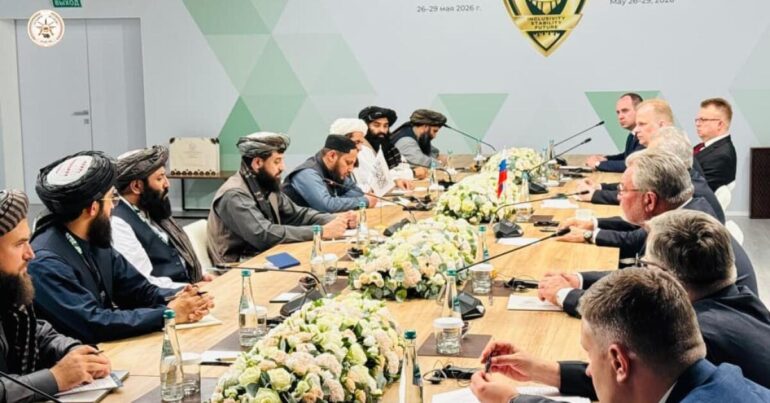

KABUL, AFGHANISTAN – Russia and the Taliban authorities signed a military-technical cooperation agreement during a security forum in Moscow on Wednesday, underscoring expanding ties between Moscow and the Taliban administration.
Russian state news agency Interfax reported that the agreement was signed on the sidelines of the Moscow Security Conference following a meeting between Taliban Defense Minister Mawlawi Mohammad Yaqoob and Sergei Shoigu, secretary of Russia’s Security Council.
Neither side released details of the agreement. However, Ukrainian media outlet United24 reported that the deal includes arms exchanges, licensing, military technologies, and joint development projects.
Yaqoob described the relationship with Russia as highly important. “Interaction with Russia has an important meaning for us. Afghanistan and Russia have long and historical relations; in this direction, we want to move further. We have expanded bilateral relations,” he was quoted as saying.
During the meeting, Shoigu said Western countries should release Afghanistan’s frozen assets, accept responsibility for their 20-year presence in the country, and contribute to Afghanistan’s reconstruction, according to the report.
The Taliban Defense Ministry confirmed that the meeting took place and said the two sides discussed bilateral cooperation and “a number of other important issues,” but made no reference to a military-technical agreement.
Moscow has gradually strengthened its engagement with the Taliban in recent years. In April 2025, Russia’s Supreme Court removed the group from its list of terrorist organizations. The Kremlin subsequently accepted a Taliban-appointed ambassador, and in July 2025, Russia became the first country to formally recognize the Taliban government.
Despite the warming ties, Russian officials continue to voice concerns about security threats emanating from Afghanistan. Earlier this month, Shoigu said between 18,000 and 23,000 fighters linked to more than 20 armed groups are operating in the country. He highlighted terrorism and drug trafficking as major risks to Central Asia’s stability.
Shoigu also noted that the Islamic State’s regional affiliate, ISIS-K, has approximately 3,000 members in Afghanistan and has carried out several major attacks in recent years.