

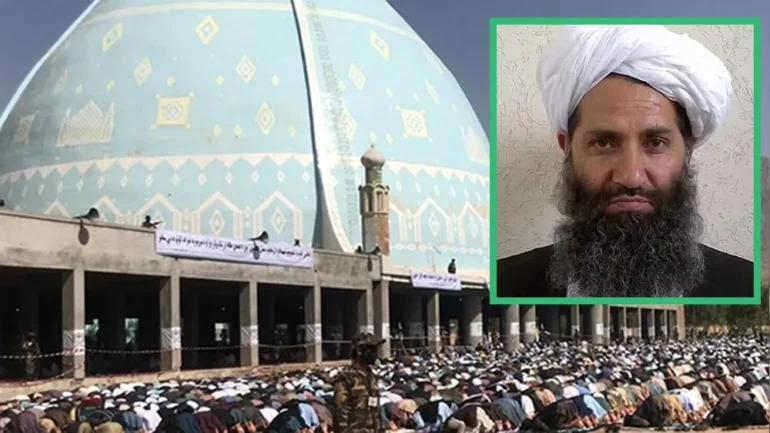

KABUL, AFGHANISTAN – Hibatullah Akhundzada, the leader of the Taliban, says that obedience to an “Amir” is “obligatory” for Muslims, and that if someone dies without pledging allegiance and obedience to an Amir, they die a death of ignorance (“Jahiliyyah”).
Speaking today (Wednesday, May 27) during Eid al-Adha prayers at the Eidgah Mosque in Kandahar, Akhundzada explained that death in ignorance refers to the era before Islam, when people did not worship Allah but instead worshipped “servants” and “idols,” adding that such a death is “a very bad death.”
In his speech, Akhundzada said that obedience to an “Amir” leads to unity and cohesion among people, but that if “even one hour passes without an Amir, sedition emerges and division appears.”
He also stated that if Muslims choose an Amir for themselves but do not obey him, unity and solidarity cannot be maintained among them; therefore, obedience to the Amir is “obligatory.”
Akhundzada, once again claiming that the Taliban govern according to “Sharia” and “Islam,” said that there is no other system in the world that operates in accordance with Islam, Sharia, and religious belief in the same way.
He called on the people of Afghanistan to fully “obey” him as the “Amir” and to follow his orders completely, emphasizing that his decrees are “religiously legitimate” and that people should not have “doubt or suspicion” regarding them.
The Taliban leader warned people not to show “disobedience,” otherwise “sedition” would arise. He added that if sedition emerges, “you have experienced what the situation in Afghanistan was like; no one had control over their property, no one had control over their honor, and no one had control over their blood.”
Akhundzada, who spent most of the nearly 50-minute speech emphasizing obedience to himself, unity, and preventing what he described as “sedition,” warned about the consequences of disobedience.
The Taliban leader has previously, on several occasions, called on people to obey him and follow his orders, while urging them to avoid division and discord.
However, through his decrees and laws that he has endorsed, Akhundzada has imposed widespread restrictions on the personal and public lives of Afghan citizens, as well as on religious, sexual, and gender minorities.
Due to issuing these decrees, he has been accused of committing “crimes against humanity,” and the International Criminal Court has issued an arrest warrant against him.
The remarks come amid growing international criticism of the Taliban’s policies and increasing concerns over restrictions on civil liberties, women’s rights, and freedom of expression in Afghanistan.
Human rights organizations and international observers have repeatedly warned that the Taliban leadership continues to consolidate power through strict ideological control and demands for absolute loyalty to its rule.
Akhundzada, a hardline cleric from the Pashtun Noorzai tribe, has led the Taliban since 2016 and consolidated his authority after the group’s return to power in August 2021. Based in Kandahar, he remains largely out of public view but holds extensive control over the Taliban’s political, military, judicial, and religious affairs, shaping the regime’s hardline policies across Afghanistan.

