

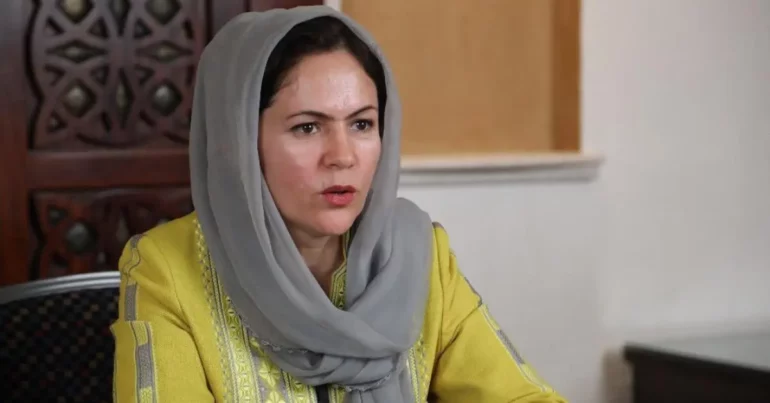

KABUL, AFGHANISTAN – Fawzia Koofi, a former member of Afghanistan’s House of Representatives, says that the Taliban have “seized” her personal home and detained a number of her relatives and individuals from Badakhshan.
Ms. Koofi confirmed today (Saturday, May 2) in a statement that her house had been confiscated and her relatives detained by the Taliban, but she did not specify the number of those arrested.
The former member of parliament said that three months ago, the Taliban raided her home and seized it, forcing several members of her family and relatives who were living there to relocate to another place.
She added that last Tuesday (April 29), the Taliban also targeted the new location and detained several of her relatives as well as “fellow citizens from Badakhshan” who had no family ties to her.
Fawzia Koofi said that the families of those detained have had no information about their condition since then. According to her, two of the detainees are also suffering from health problems.
She described the attack as “a cowardly act,” stating that it shows the Taliban are in a state of weakness, instability, and collapse, while at the same time demonstrating that the struggles of Afghan women have been impactful and decisive.
The former parliamentarian emphasized that she will continue her struggle “until freedom is achieved and the dignity and human rights of the people are restored.”
Previously, local sources had reported the arrest of several of Koofi’s relatives by Taliban intelligence in Kabul. Sources also reported that the Taliban detained Homayoun Khahani, an engineer from Badakhshan, last Tuesday, and there is still no information about his fate.
Taliban officials have not yet commented on the seizure of Koofi’s home or the detention of her relatives.
Since regaining control of Afghanistan, the Taliban have also confiscated the homes and properties of several other political figures in the country. The group has also been accused of detaining and torturing relatives of officials and military personnel from the former Afghan government.
Meanwhile, a recent report by Rawadari, published in April 2026, highlights a broader pattern of human rights concerns that provide context to such incidents. According to the report, at least 611 civilians were killed or wounded in targeted, suspicious, or extrajudicial attacks in 2025—an increase of over 40% compared to 2024. Among them, 378 civilians were affected in suspicious or extrajudicial attacks, including 257 deaths.
Furthermore, the report notes that former government employees, civil society members, and individuals accused of links to opposition groups remain among the primary targets. At least 80 former government employees were specifically targeted, while 40 civilians were killed by Taliban forces on accusations of cooperating with opposition groups. It also documents 11 deaths in Taliban-controlled prisons following severe torture.
In addition, the report points to a sharp rise in arbitrary detentions and enforced disappearances. In 2025, at least 2,559 individuals were unlawfully detained—more than double the number recorded in 2024. These included former government employees, human rights defenders (including women), and individuals accused of opposition ties. The Taliban were also reported to have detained 2,125 people, including 88 women, mainly for alleged violations of morality rules.
Moreover, Rawadari documented 66 cases of enforced disappearances across 12 provinces, marking a nearly 30% increase compared to the previous year. Victims were largely from vulnerable or targeted groups, including former officials and community figures.
Taken together, these findings reinforce concerns that incidents like the reported seizure of Koofi’s home and the detention of her relatives are part of a wider pattern of repression, arbitrary action, and human rights violations under Taliban rule.

