

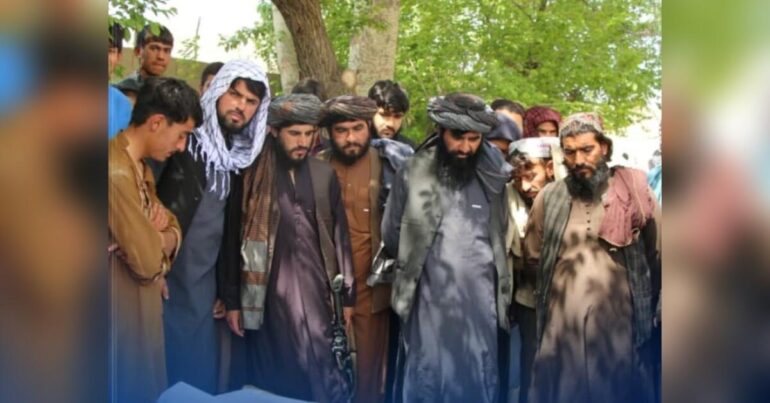

KABUL, AFGHANISTAN – The Taliban governor’s office in Logar says that “unknown armed individuals” have killed four members of a family in the center of the province.
Mirwais Abedali, spokesperson for the Taliban governor in Logar, said that the incident took place last night (Sunday, April 26) in the “Hesarak” area of Pul-e-Alam city, the provincial capital.
He added that the victims include a woman, a 60-year-old man, and two sons aged 23 and 13.
The Taliban’s police command in Logar has also confirmed the incident and said that three people have been arrested in connection with the killings.
Following the Taliban’s return to power in Afghanistan, cases of killings in various provinces of the country have increased significantly.
Many of these killings are attributed to “unknown armed individuals,” and the Taliban rarely report the identification and punishment of those responsible.
Similarly, one week ago, local sources in Kandahar reported that a 32-year-old driver named Janan was stabbed to death in the second district of Kandahar city. According to the sources, the incident occurred on the evening of Saturday, April 18, after the driver transported one man and two women to a garden, where he was attacked and killed by the passengers, who then fled the scene. The victim was known for working as a driver along the Kabul–Kandahar highway.
A report released in March 2026 by the UK-based human rights group Rawadari documented at least 611 cases of targeted, suspicious or extrajudicial killings and injuries across Afghanistan in 2025 — a rise of more than 40% from the previous year. The victims included former government employees, individuals accused of links to opposition groups, protesters, tribal elders and other community figures.
Taliban authorities have repeatedly claimed that they have restored order and enhanced security compared with the period before 2021. However, human rights groups and ordinary Afghans continue to criticize them for failing to protect civilians and for conducting transparent investigations into such crimes.
Furthermore, these incidents reflect an ongoing pattern of insecurity and lack of accountability, raising concerns among residents about personal safety and the continuation of unresolved criminal cases across different regions of Afghanistan.
This incident reflects the broader concerns about public safety and the lack of transparent investigations into violent crimes in Afghanistan, where many cases remain unresolved and perpetrators often go unidentified.

