

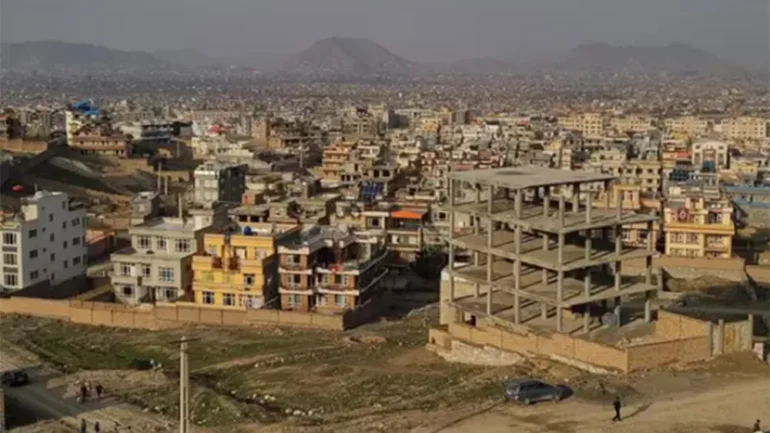

KABUL, AFGHANISTAN -The Taliban’s Ministry of Justice says that more than 1,507.49 jeribs of land (approximately 3.01 square kilometers) belonging to the “Omid Sabz Township” in western Kabul has been designated as “state-owned” based on a ruling by the group’s special court.
In a statement released today (Sunday, April 26), the ministry said that the Special Court for Addressing Cases of Usurped State Lands in the Central Zone, after reviewing the documents and records of 1,507.49 jeribs of land known as Omid Sabz Township in western Kabul, had decided that all of the land was state-owned.
The Taliban’s Ministry of Justice claimed that the special court, “after thoroughly examining the documents and records of the occupants and the commission, land registration offices, and obtaining information from relevant authorities, determined that the entire land, in five cadastral sections, had been registered and surveyed in the name of the state and had not been transferred to any natural or legal persons.”
The ministry added that therefore, the court “ruled that all of the said land is state-owned and should be handed over to the Commission for the Prevention of Land Usurpation and the Restitution of Usurped Lands.”
According to the Taliban’s Ministry of Justice, the land is located in the 6th and 13th districts of Kabul, and the “Commission for the Prevention of Land Usurpation and the Restitution of Usurped Lands” had previously referred the case to the “Special Court for Addressing Cases of Usurped State Lands in the Central Zone.”
“Omid Sabz Township” is located in western Kabul, and its residents are mostly Hazara. The township has been developed over the past twenty years, and it is said that Mohammad Nabi Khalili, the brother of Mohammad Karim Khalili, a former Vice President of Afghanistan, is one of its major shareholders.
This decision could have significant social and economic consequences for the residents of Omid Sabz Township, particularly given that many families have lived there for years and invested in property and infrastructure. Concerns over transparency, legal due process, and the protection of property rights are likely to intensify as similar cases continue to emerge across the country.
Hazaras who have long been targeted by multiple militant groups, particularly the Taliban, have found themselves more vulnerable with the group’s return to power. Reports show that thousands of Hazaras have been forcibly displaced, their lands and other properties confiscated by the Taliban or groups affiliated with them in Daikundi, Maidan Wardak, Helmand, Uruzgan, Sar-e-Pul and other provinces.
Bamyan, where the giant statues of Buddha the Taliban exploded in 2001 was located, was considered one of the few strongholds for the Hazaras during the republican government. As such, the province has particularly suffered since the Taliban took power.
In August 2022, The United States Holocaust Memorial Museum called for urgent action to address the plight of Hazaras in Afghanistan under the Taliban. Despite promises to protect the Hazaras from threats, the Taliban have committed targeted attacks and have forcibly displaced thousands of Hazara civilians, their statement said.
Since regaining control of Afghanistan, the Taliban have reviewed dozens of townships and declared their lands as “state-owned,” but property owners have complained about the lack of impartial review of their documents and evidence during the process.

