

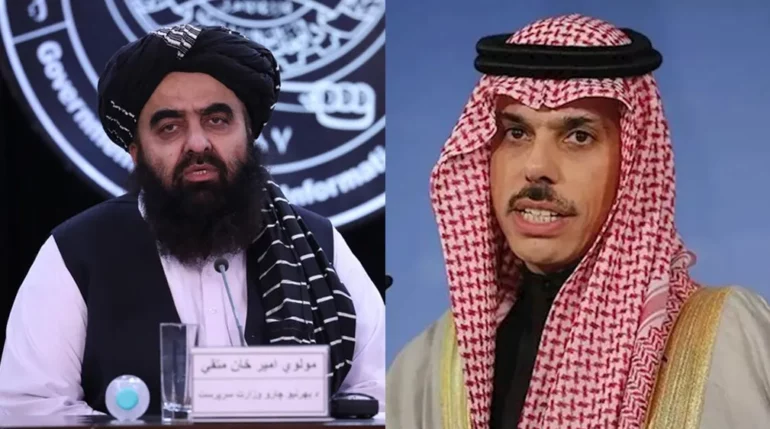

KABUL, AFGHANISTAN – Amir Khan Muttaqi, the Taliban’s Minister of Foreign Affairs, has held a phone conversation with Faisal bin Farhan, the Minister of Foreign Affairs of Saudi Arabia.
The Taliban’s Ministry of Foreign Affairs said in a statement released this evening (Sunday, April 26) that the two sides discussed “bilateral relations, facilities for Afghan residents in Saudi Arabia, and regional issues.”
During the call, Muttaqi emphasized the expansion of bilateral relations between Taliban-controlled Afghanistan and Saudi Arabia and expressed appreciation for Saudi Arabia’s efforts toward regional stability.
The Taliban’s foreign minister also thanked Saudi Arabia for facilitating the “transfer of information” to Afghan citizens residing in the country and called for increasing the human capacity of Taliban diplomatic missions in Saudi Arabia to better advance affairs.
According to the Taliban’s statement, the Saudi foreign minister also emphasized the development of diplomatic relations and welcomed the increase in the capacity of diplomatic missions.
The Saudi foreign minister further described regional stability as important for all and stressed the need for dialogue and diplomacy to end conflicts.
Recently, Saudi Arabia has played a cautious but notable mediating role between Afghanistan under Taliban control and Pakistan, particularly as tensions escalated along the border.
It comes at a time when, relations between the Taliban authorities in Kabul and the government of Pakistan have remained tense and fragile. Despite periodic diplomatic contacts and efforts to manage border security, mutual distrust continues to overshadow ties.
Islamabad has repeatedly pressed the Taliban to take action against the Tehreek-e-Taliban Pakistan (TTP), while Taliban officials insist they do not allow Afghan territory to be used against other countries. Sporadic border closures, security incidents and sharp rhetoric from both sides have further strained relations, leaving the future of bilateral cooperation uncertain.
Meanwhile, Riyadh has sought to use its diplomatic influence and longstanding ties with both sides to encourage de-escalation and dialogue. This role became more visible when Saudi Arabia facilitated the release of three Pakistani citizens held by the Taliban, signaling its willingness to act as a bridge in sensitive situations.
However, these mediation efforts have faced setbacks; shortly after the release, Pakistan conducted airstrikes in parts of Afghanistan, triggering a new wave of clashes and undermining confidence-building efforts.
Despite this, Saudi Arabia continues to emphasize the importance of stability, dialogue, and diplomatic engagement, reflecting its broader regional strategy of conflict management and political balancing rather than direct intervention.
This development highlights the ongoing complexity of regional dynamics, where diplomatic engagement continues alongside unresolved tensions, underscoring the importance of sustained dialogue and confidence-building measures to achieve long-term stability.

