

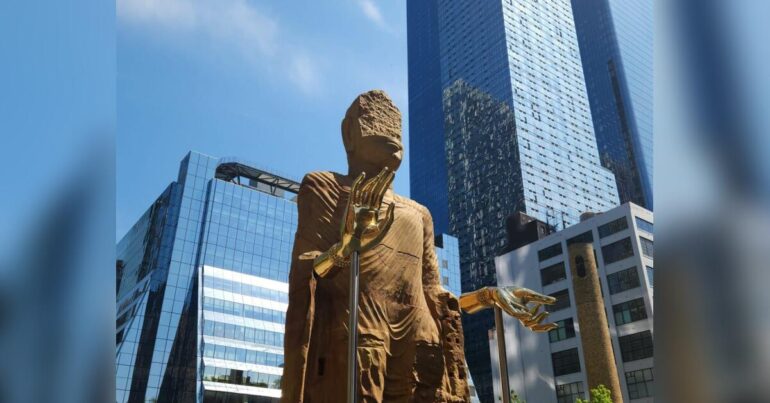

KABUL, AFGHANISTAN – A sandstone sculpture inspired by the Buddha of Salsal in Bamiyan has been put on display at the High Line park in Manhattan, New York, United States.
The sculpture was created by Tuan Andrew Nguyen, a Vietnamese-American artist, who named it based on the meaning of the word “Salsal” as “light that shines across the world.”
According to the website Hyperallergic, the sculpture stands 27 feet tall and has recently been installed at the intersection of West 30th Street and 10th Avenue in Manhattan, where it will remain on public display until the spring of 2027.
“This sculpture creates a friction with the surroundings here in New York. It’s not sleek like everything else you can see here,” High Line’s art director and chief curator Cecilia Alemani said to Hyperallergic. “It offers a hint to the public that temporality is not necessarily a straight line, that things can come back almost like in a wheel.”
Based on the report, Nguyen—who has repeatedly engaged in reconstructing or reinterpreting war-related materials linked to the Vietnam War in his works—has taken a similar approach in this piece as well.
For the hands of the sculpture, which are separate from the stone body, he used the same method.
He said that through a number of his friends in Bamiyan, Afghanistan, he was able to obtain alloys from war munitions (such as spent bullet casings), which were then transported across the Pakistan border.
The artist stated that he then transformed these alloys into “mudras,” symbolic hand gestures in Buddhist and Hindu traditions, and later transferred them to Vietnam, where the sandstone was extracted and carved.
According to Hyperallergic, the shine of these hands under sunlight conveys a specific meaning: the right hand is in the “Abhaya Mudra” (a gesture of fearlessness), while the left hand is in the “Varada Mudra” (a symbol of generosity and sincerity).
Nguyen said that his sculpture is not a copy of the Buddha of Salsal in Bamiyan, but rather a reflection of it.
He said that stories, ideas, and memories remain alive through retelling, and that when he engages in the process of recreation, it feels as though he is narrating the story again, expressing it through his own perspective and artistic vision.
Nguyen emphasized that the sculpture is not a replica of the lost heritage, but rather an “echo” of it. “ You keep a story, idea, or memory alive by retelling,” he explained. “When I engage in this process of remaking, it’s like retelling the story. It gets translated through my hands and eyes.”
The giant Buddha statues known as “Salsal” and “Shahmama” were built in the 6th century in Bamiyan, central Afghanistan.
The Buddhas statues of Salsal and Shahmama, carved into the mountains between 300 and 700 AD, stood at 53 and 35 meters tall, respectively. These ancient statues were significant cultural and historical artifacts.
In March 2001, during their previous rule, the Taliban detonated explosives to destroy the Buddha statues, despite widespread international condemnation and appeals. The decision was based on a fatwa issued by Mullah Omar, the leader and founder of the Taliban.
The destruction of the Buddha statues, which were listed as a UNESCO World Heritage Site, sparked widespread global reactions at the time.
The Japanese Ambassador to Afghanistan, Takashi Okada, visited the ruins of the Bamiyan Buddhas during a trip to the province, highlighting their importance as a valuable cultural heritage site. He praised the efforts of experts and archaeologists for their work in preserving the historic remains, describing the site as a significant asset for the people of Bamiyan.
After the collapse of the Taliban government, the former Afghan government and UNESCO made several attempts to reconstruct the statues; however, UNESCO ultimately decided not to rebuild them due to the insufficient remaining material from the original structures.
This artwork, therefore, can be seen as part of a broader international effort to preserve cultural memory and reinterpret lost heritage through contemporary art, highlighting how history, conflict, and identity continue to shape artistic expression across borders.

