

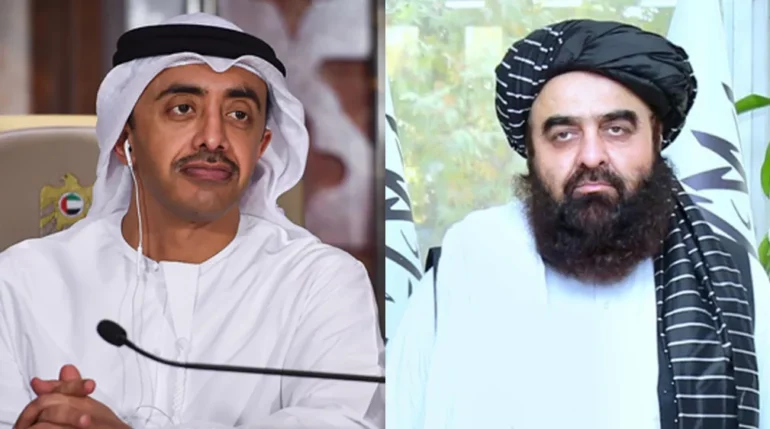

KABUL, AFGHANISTAN – The Taliban Ministry of Foreign Affairs has reported a telephone conversation between Amir Khan Muttaqi, the Foreign Minister of this group, and Abdullah bin Zayed Al Nahyan, Deputy Prime Minister and Foreign Minister of the United Arab Emirates, regarding the regional situation and the war with Pakistan.
According to a statement from the Taliban Ministry of Foreign Affairs, Muttaqi said in the phone call that the United States and Israel had started a war against Iran, which threatens the security of the entire region.
The Taliban’s Foreign Minister also described the “expansion of war in the region as a worrying provocation and condemned it, adding that the patience and prudence of the United Arab Emirates are commendable.”
Muttaqi also said that the Taliban seeks to resolve problems with Pakistan through dialogue and understanding and will not allow anyone to use Afghan soil against Pakistan.
He added that the Taliban has taken serious measures in this regard.
The Taliban’s Foreign Minister stated that all military actions by this group against Pakistan have been defensive and that, in case of aggression, they reserve the right to legitimate self-defense.
According to the statement of the Taliban Ministry of Foreign Affairs, the Foreign Minister of the United Arab Emirates said that tensions between the Taliban and Pakistan are not in the interest of either side and that his country will continue its efforts to resolve the issues.
The Foreign Minister of the United Arab Emirates also said that special attention will be given to the security of Afghan citizens residing in that country in light of the new security conditions.
The current developments come amid rapidly escalating regional tensions, particularly due to the ongoing conflict between Iran, the United States, and Israel. The war, which began in late February, has expanded beyond Iran’s borders, raising fears of a wider regional confrontation involving multiple actors and threatening key economic and security routes in the Middle East.
Recent reports indicate that the conflict has already caused significant casualties and instability, with growing concerns about further military escalation and its impact on neighboring countries.
At the same time, tensions between Afghanistan and Pakistan have intensified in recent weeks, with cross-border strikes and military exchanges reported from both sides.
Pakistan has experienced a marked increase in militant attacks, particularly in the border provinces of Khyber Pakhtunkhwa and Balochistan. Security forces, checkpoints, and civilians remain frequent targets of groups, including the TTP and the Baloch Liberation Army (BLA). Islamabad accuses the Afghan Taliban of supporting and providing safe havens to TTP and other militant groups, a claim the Taliban denies.
Regional and international actors have repeatedly called for dialogue to prevent further escalation, warning that continued conflict could worsen the humanitarian situation and destabilize the broader region.

