


KABUL, AFGHANISTAN – Officials from the Taliban say Pakistan has continued attacks on several provinces of Afghanistan over the past 24 hours, leaving civilians dead and wounded and causing significant destruction to homes, markets and other infrastructure.
Hamdullah Fitrat, deputy spokesperson for the Taliban, said in a statement on Saturday (March 7) that Pakistani forces carried out attacks in the provinces of Paktia, Paktika, Khost and Kunar.
According to Fitrat, at least four civilians were killed and three others injured in the attacks, while several homes were destroyed.
He said Pakistani forces targeted “civilian houses and markets” in the districts of Dand Patan District and Chamkani District in Paktia province. One person was killed and another injured in the strikes. The attacks reportedly destroyed 10 houses, 14 shops, two markets and a mosque in the two districts.
Fitrat added that Pakistani forces also fired on villages and markets in the districts of Shagin District and Barmal District in Paktika province. Two civilians were killed in the market of Shagin district, while six houses and several shops were destroyed in the two districts.
He further said that Pakistani air strikes in the districts of Ali Sher District and Terezai District in Khost province killed one person and injured two others. Ten houses and a mosque were damaged, and more than 100 families were displaced as a result.
In Zazi Maidan District in Khost province, one house was reportedly struck by Pakistani forces but there were no casualties, although the building was destroyed.
Fitrat also claimed that Pakistan fired 60 rockets toward Nari District in Kunar province over the past 24 hours. He said the attack caused no casualties but resulted in financial losses, including damage to a water dam.
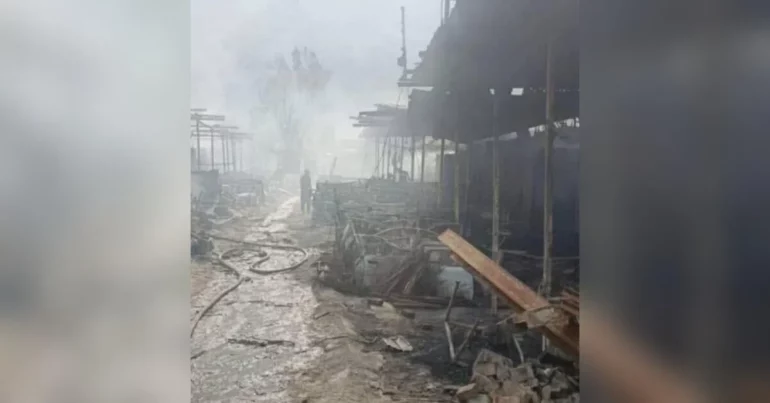
Separately, Taliban local officials in Nangarhar Province reported that a Pakistani missile strike hit a commercial market in Torkham, causing extensive damage to traders.
Quraishi Badlon, head of information at the Taliban’s Department of Information and Culture in Nangarhar, said the strike occurred at around 4:00 a.m. on Saturday.
According to him, the missile attack triggered a major fire in the market, with more than 150 shops burned so far. He said firefighting teams were present at the scene but the fire had not yet been fully contained.
Badlon added that the damage caused to traders in the market is estimated at around 300 million Afghanis.
Fighting between the Taliban and Pakistan has now entered its second week. During this period, Pakistan has carried out air and rocket strikes in several areas of Afghanistan.
Taliban officials say dozens of residential homes have been destroyed and civilians have suffered heavy losses as a result of the attacks.
Meanwhile, the United Nations Assistance Mission in Afghanistan (UNAMA) has reported that Pakistani attacks on Afghanistan have left 185 civilians killed or wounded, while thousands of families have been displaced.
The latest clashes began on 27 February after the Taliban launched a retaliatory operation against Pakistani positions following earlier Pakistani airstrikes in Nangarhar and Paktika. Pakistan has since conducted additional airstrikes while cross-border fighting continues. Both sides claim to have inflicted heavy losses, though independent verification of military casualties is unavailable.
Regional leaders, including Turkey’s President Recep Tayyip Erdoğan, and countries such as Russia and China, have offered to mediate and called for de-escalation. The United Nations and several governments have urged an immediate halt to hostilities.
The clashes are the latest in a series of confrontations along the Pakistan-Afghanistan border. Previous fighting in October 2025 lasted several days and led to dozens of deaths before a fragile ceasefire was mediated by Qatar and Turkey. Border crossings remain closed, halting trade and movement of people and causing significant financial losses for traders.

