

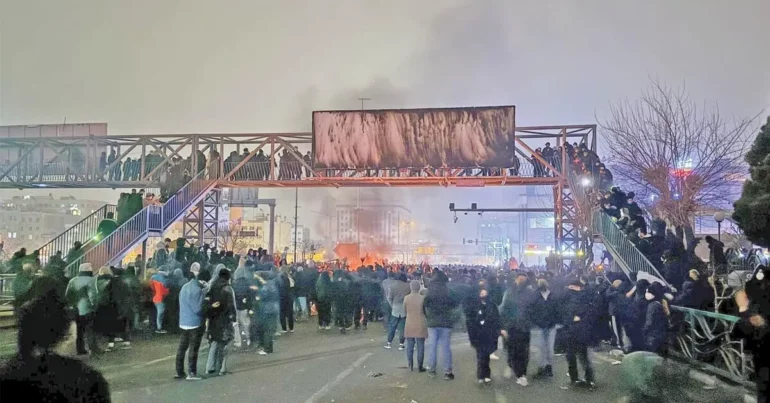

KABUL, AFGHANISTAN – United Nations human rights experts, including the UN Special Rapporteur on Afghanistan, have said that Afghan citizens are among those killed and detained during recent protests in Iran, although no official figures have yet been released.
In a joint statement, the experts said: “The true scale of the violent crackdown on Iranian protesters remains impossible to determine at this point. The discrepancy between official figures and grassroots estimates only deepens the anguish of families searching for their loved ones and displays a profound disregard for human rights and accountability.”
The Iranian government has confirmed that 3,117 people were killed and around 3,000 were arrested during the unrest. However, human rights organizations estimate the number of casualties and detentions to be in the tens of thousands.
Recently, former US President Donald Trump claimed that 32,000 people were killed in Iran within a short period. Iran’s Foreign Minister, Abbas Araghchi, rejected the figure and called on Trump to provide “evidence” to support his claim.
According to the UN experts’ statement, the vast majority of those detained or killed were ordinary civilians, including children, from across Iran’s provinces and diverse ethnic and religious backgrounds, as well as Afghan nationals. Richard Bennett, the United Nations Special Rapporteur on Afghanistan, wrote on his page on X: “The vast majority of those detained or killed are ordinary people, including children, from all provinces and diverse ethnic and religious backgrounds, as well as Afghan nationals, of which there are some 5 million living in #Iran.”
They said those arrested include lawyers who sought to represent protesters, medical professionals who treated the wounded, journalists and writers, artists, and human rights defenders who supported the demonstrations.
Human rights experts said families across Iran remain unable to locate their relatives, whether among the injured in hospitals, those held in detention centres, or the dead in forensic facilities. Many families of known detainees have reported being denied regular contact, heightening concerns about the safety of their loved ones.
“When a State refuses to account for the whereabouts of its people, others will fill that void — and the picture that emerges will define this period in Iran’s history,” the experts said. “The people of Iran have a right to know what is happening in their own country. Without answers, we will assume the worst.”
The experts urged Iranian authorities to immediately halt all executions, including those linked to the protests, and to clarify the fate and whereabouts of those who have disappeared. They also called for the release of all individuals arbitrarily detained during and after the protests.
The unrest began in the month of December over rising prices and inflation, before escalating into anti-government demonstrations. The protests were met with a heavy crackdown, with reports that the most intense violence occurred on 18 and 19 December. During the protests, authorities imposed a complete internet shutdown. “Full connectivity is reserved for State-approved users. For the wider population, access is severely restricted, frequently dependent on expensive and difficult-to-obtain VPN services, leaving many cut off from reliable connectivity.”
Different figures have since been reported regarding the number of casualties.
The Iranian government has described the protests as riots and terrorist operations.
In response to Trump’s remarks, Araghchi wrote on his account on the social media platform X that, “fulfilling our pledge of full transparency towards our own people, Iran’s Government has already published a comprehensive list of all 3117 victims of recent terrorist operation, including about 200 officers. If anyone disputes accuracy of our data, please share any evidence.”
Iranian officials have not commented on the number of Afghan citizens among those killed or detained. However, during the protests, state media repeatedly reported the arrest of foreign nationals.
During the 12-day conflict, Iranian authorities also levelled broad accusations against Afghan citizens, including allegations of espionage and involvement in drone operations.
Following the conflict, Iran deported hundreds of thousands of Afghan nationals to Afghanistan.

