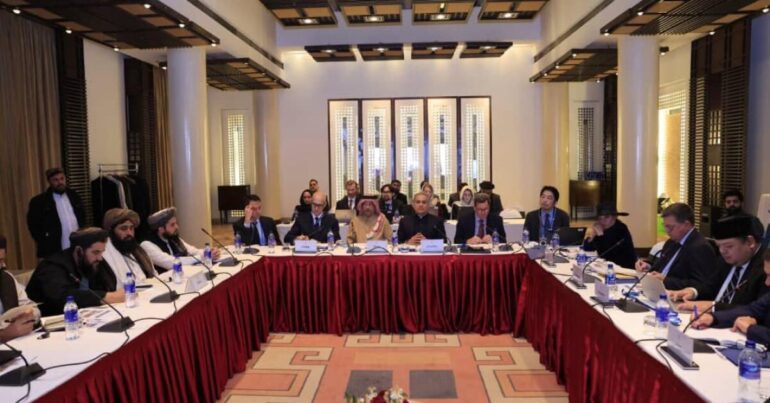

KABUL, AFGHANISTAN – The UN held the fourth counter-narcotics working group meeting under the Doha process in Kabul on Wednesday, bringing together Taliban officials, international organizations, diplomats, and experts to discuss efforts to curb drug production and trafficking, the Taliban said.
In a statement, Zia Ahmad Takal, deputy spokesperson of the Taliban Ministry of Foreign Affairs, said the meeting was hosted by the UN Assistance Mission in Afghanistan (UNAMA) at the Kabul Grand Hotel.
He said representatives from Taliban ministries, UN agencies, regional and international organizations, the European Union, the Organization of Islamic Cooperation, diplomats, ambassadors, and technical experts attended both in person and virtually.
The statement said Taliban representatives highlighted that following the group’s ban on opium cultivation, production across Afghanistan has fallen to nearly zero. They raised concerns about the rise of synthetic drugs, noting that the sources of these substances lie outside Afghanistan’s borders and could affect the region and the international community if not controlled.
According to the statement, other participants welcomed the reduction in poppy cultivation, calling it an “unprecedented development for Afghanistan’s history.” Several attendees pledged support for counter-narcotics initiatives and emphasized the need for coordinated action both under the Doha process and through bilateral engagements.
Participants also emphasized that sustaining these gains would require alternative livelihoods for farmers and expanded rehabilitation and reintegration programs for people with drug dependence.
The UN has not yet commented on the meeting or its discussions.
In April 2022, Taliban leader Hibatullah Akhundzada ordered a ban on the cultivation of opium poppies and the production, trade, and trafficking of narcotics in Afghanistan. UN reports show the ban significantly reduced poppy cultivation, though it continues in some areas due to farmers’ reliance on the crop amid poverty and food insecurity.
UN assessments also indicate that synthetic drug production, particularly methamphetamine, has increased in recent years. These substances are easier to produce, harder to detect, and increasingly profitable for organized criminal networks.
The Doha process, launched by the UN in 2023, facilitates engagement with Taliban authorities on issues such as counter-narcotics, humanitarian aid, and private-sector development. The counter-narcotics and private sector working groups were established in late 2024 and have held several meetings, previously all in Doha, Qatar.
The latest session follows a recent visit to Kabul by Rosemary DiCarlo, UN Under-Secretary-General for Political and Peacebuilding Affairs, who met senior Taliban officials to advance the Doha process and related matters.