


KABUL, AFGHANISTAN – The United Nations and several regional countries called on Pakistan and Afghanistan’s Taliban authorities on Friday to de-escalate and protect civilians after renewed cross-border clashes and airstrikes sharply raised tensions.
Fighting flared again on Thursday evening when Taliban fighters launched what they described as retaliatory attacks against Pakistani military posts at multiple points along the border. Taliban authorities said the attacks were in response to Pakistani airstrikes earlier this week in eastern Afghanistan that caused multiple casualties, including civilians.
The Taliban also claimed on Friday that they had carried out air operations targeting military sites inside Pakistan, including locations in Islamabad and the Hayatabad area. Pakistani officials did not immediately confirm those claims.
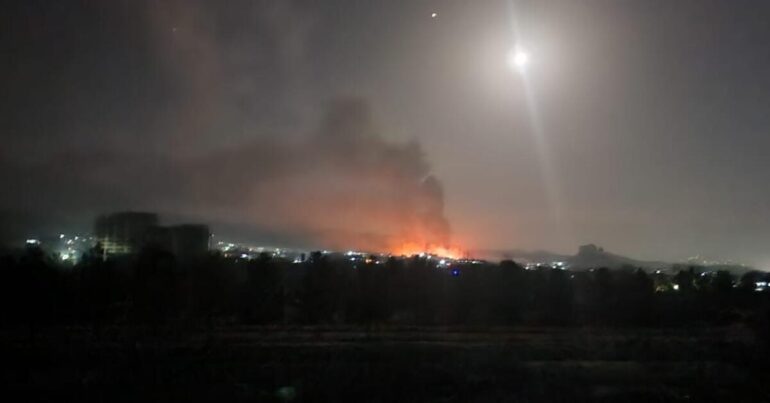
In the early hours of Friday, Pakistan announced the launch of what it called “Operation Ghazab Lil Haq,” carrying out airstrikes deep inside Afghanistan. The Pakistani military said the strikes targeted “key military installations” belonging to the Taliban in Kabul, Kandahar, and Paktia provinces.
Both sides issued differing accounts of the scale of losses. Taliban authorities said 55 Pakistani soldiers were killed, while Pakistan’s military said at least 228 Taliban fighters were killed and more than 314 wounded during overnight clashes and airstrikes. Taliban officials also said at least 13 civilians were killed and many others injured in a Pakistani attack on a “refugee camp” in Nangarhar province.
Pakistan’s military confirmed that 12 of its soldiers were killed and 27 others wounded during the fighting.
No independent sources have verified the casualty figures provided by either side.
As hostilities intensified, rhetoric between officials in Kabul and Islamabad also escalated. Pakistan’s Defence Minister Khawaja Asif described the Taliban as acting on behalf of India and said Pakistan’s patience had “run out,” characterizing the situation as an “open war.”
The UN Secretary-General, Antonio Guterres, expressed deep concern over the surge in violence. In a statement delivered by his spokesperson, he urged both sides to strictly comply with international law, particularly international humanitarian law, and stressed the urgent need to prioritize the protection of civilians.
The UN Special Rapporteur on human rights in Afghanistan, Richard Bennett, separately called for immediate de-escalation, urging all parties to exercise restraint and respect international human rights and humanitarian law, with a particular emphasis on safeguarding civilians
Regional powers also weighed in, urging an end to hostilities and offering to mediate. Iran, Russia, and China called on both sides to halt attacks and pursue dialogue to prevent further escalation.
Iran’s foreign minister, Abbas Araghchi, said in a post on X that the dispute should be resolved through dialogue and good neighborly relations, noting the significance of the holy month of Ramadan as a period of restraint and Islamic solidarity. He added that Tehran was ready to provide any assistance needed to facilitate constructive talks between Kabul and Islamabad.
Russia’s special envoy for Afghanistan, Zamir Kablov, said Moscow supported a diplomatic solution and was prepared to help mediate if requested by both parties. China’s foreign ministry said Beijing was “deeply concerned” about the escalation and stood ready to play a constructive role in cooling tensions through its own channels.
Relations between Islamabad and the Taliban authorities, once close, have deteriorated sharply over the past year, with Pakistan pressing the Taliban to act against militant groups it says operate from Afghan territory. The Taliban deny the accusations and say Pakistan should address its own internal security challenges.
A previous major confrontation in October last year, which lasted several days and resulted in dozens of casualties on both sides, ended after mediation efforts led by Qatar, Turkey, and Saudi Arabia. Although a ceasefire agreement was reached at the time, subsequent talks aimed at a longer-term arrangement stalled, with Pakistan reportedly seeking written guarantees from the Taliban to rein in militant groups.

