

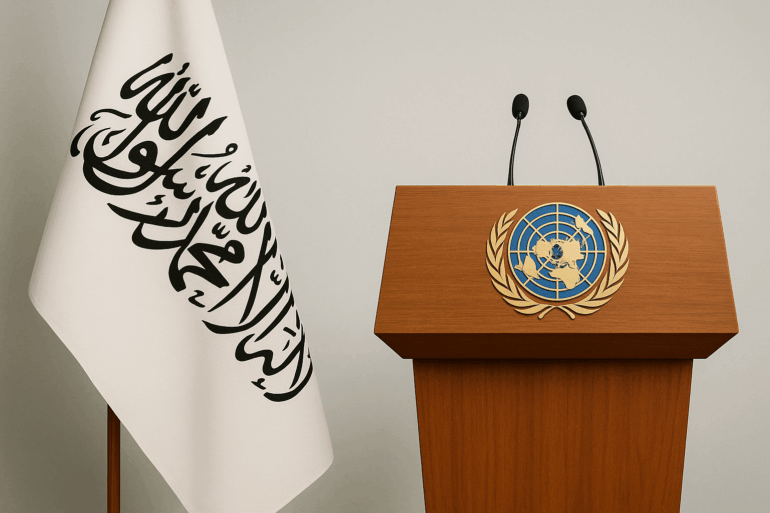

Mohammad Zaman Sirat
The Taliban, which currently rules Afghanistan without formal legitimacy, provides a suitable point of departure for examining the politics of recognition. Recognition in international relations encapsulates the law of states, the social significance of legitimacy, and the operational realities of power. Yet this simple statement can be misleading. From an empirical perspective, other political groups have long exhibited state-like qualities without receiving diplomatic recognition. From a sociological perspective, however, the issue highlights a crucial implication: a territory regarded as a state by international institutions, despite their official non-recognition of the ruling authority, has been seized and administered by a powerful military organization.
This dilemma between rule and recognition generates political, social, and humanitarian consequences that demand rigorous analysis. In August 2021, the Taliban’s return to power cemented this dilemma in Afghanistan’s recent history and made the question of recognition unavoidable in both domestic and international debates.
Recognition and Global Order
Legal and symbolic recognition both occur. As a matter of international law, recognition is a symbolic gesture with real-world consequences, enabling financial transfers, treaties, and entry into multilateral groups. From the perspective of other countries, international institutions, and transnational actors such as banks and non-governmental organizations, recognition symbolically grants legitimacy. From a sociological standpoint, recognition makes a de facto regime a de jure player in international politics and is a form of institutionalized social validation. Nevertheless, statehood scholars have shown that for residents under a regime, material control and bureaucratic capacity often outweigh formal recognition. Whether or not a foreign ministry delivers credentials at the U.N. is of less consequence in the day-to-day lives of most Afghans than whether there is road maintenance, functioning hospitals, running water, paid teachers, and operating courts.
Recognition of the Taliban as Afghanistan’s legitimate government was not granted by the United Nations nor by major western nations. Afghanistan’s standing and representation remain legislatively ambiguous as a direct product of the UN’s accrediting process, alongside continued acknowledgement of the entity of “Afghanistan” as a nation for technical and humanitarian purposes. Such a liminal status, government without express diplomatic recognition, has had grave consequences.
Recognition also shapes identity and memory. For many Afghans, the Taliban’s return recalls the repression and widespread human rights violations of the 1990s—abuses that have once again become a defining feature of daily life in Afghanistan. For others, it represents a return to order after years of corruption and conflict. International recognition would not only determine which of these narratives the world accepts, but also reveal whether global powers prioritize human rights and justice or political expediency and convenience. Recognition carries a moral voice that will shape how future generations understand justice, responsibility, and sovereignty.
The Costs of Nonrecognition
The direct and lasting consequences of delaying recognition are most evident in Afghanistan’s financial collapse. Since 2021, a significant proportion of the country’s foreign exchange reserves have been frozen abroad, limiting fiscal policy and crippling central bank operations. Despite growing humanitarian needs, the West and international financial institutions have been reluctant to reassess full membership, given the continued postponement of formal recognition. The United States and other countries have put in place procedures to freeze or restrict access to billions of central bank reserve dollars, and many donor programs have been either revised or terminated, in order neither to further entrench the de facto authorities nor to reward their administrative control.
Financial dynamics have drastically transformed social relations: markets experience liquidity shocks, pension schemes are interrupted, private credit has become more stringent, and government officials may go unpaid or receive inadequate compensation. The social and economic consequences include increased volatility, stronger pressures for emigration, and the transformation of household survival strategies.
International organizations have attempted to deliver humanitarian aid while denying legal recognition, adopting what can be described as a pragmatic course of action. To prevent famine, agencies such as the World Food Program and the United Nations system have increased their activity; nevertheless, their ability to function depends on gaining access and protection under a given political context. That context limits the number of women workers, restricts their movement, and imposes new social norms. The contradiction is striking: while foreign agencies keep their distance from Afghanistan’s ruling authority, they simultaneously describe the country as suffering from a nationwide humanitarian crisis.
Such an “engage but do not recognize” policy breeds ethical and logistical challenges. Donors fear that money may be diverted or that recognition of aid would normalize the ruling government. These limitations imposed on humanitarian workers in the field have large-scale impacts on the distribution and allocation of assistance, and on the actors who receive it.
The Taliban’s gender policy is another key obstacle to recognition. Since 2021, restrictions have been placed on women’s participation in public life, bans have excluded women from positions in NGOs, and girls have been denied access to secondary and higher education. These measures reconstruct labor markets, alter gender norms, and affect Afghan families’ opportunities for building intergenerational ties. Many international actors interpret formal recognition under these conditions as approval of exclusion based on gender. From a sociological viewpoint, the Taliban’s gender rules serve as tools of social order; a reconstruction of public space, citizenry, and personhood, which carries symbolic value in the contest over international legitimacy.
Authority and Comparative Lessons
The Taliban’s operations as a ruling entity can be explained through classic sociological frameworks. Monopolistic control of violence across much of Afghanistan points strongly to Max Weber’s idea of the state’s monopoly over the legitimate use of coercion. The Taliban’s transition from insurgency to governance reflects Charles Tilly’s statement: “war made the state, and the state made war.”
Michael Mann’s distinction between despotic and infrastructural power is also relevant. The Taliban wield significant despotic power through direct control over daily life, but their infrastructural power—including taxation, recordkeeping, and service provision—is uneven and heavily dependent on foreign aid and legacy institutions left by the previous administration. Pierre Bourdieu’s concept of symbolic capital explains why international recognition matters: it provides legitimacy, access to resources, and a narrative of authority. These frameworks are not empirical validations but should be understood as heuristics.
Yet Afghan governance remains fragmented. Implementation of central policies is shaped by ethnic and provincial differences, regional power brokers, militia networks, and an expanding underground economy. Instead of centralized rule, many regions function through negotiated orders. Variation in Taliban governance is evident among localized warlords, pragmatic bureaucrats, and religious hardliners. The result is uneven services, differential security provisions, and communities that either diverge from or reinterpret Taliban policies.
Comparisons with Somaliland clarify the trade-offs of nonrecognition. Despite its lack of recognition, Somaliland managed to build workable institutions, elections, and relative stability. But Afghanistan’s case is distinct: its larger territory, status as a UN member, and massive past investment in state-building make the Taliban’s situation unique. The lesson is that outcomes depend on the interplay of domestic capacity, external aid, and the quality of governance imposed by de facto rulers.
Most states have therefore chosen a middle road: conditional engagement without formal recognition. Humanitarian aid continues, technical contacts occur, and sanctions maintain pressure. At the same time, investment in women’s networks, local institutions outside Taliban control, and civic resilience is critical. These approaches signal expectations and build incentives at the grassroots level without legitimizing Taliban rule.
Conclusion
What it means to be “unrecognized” in the international system—running a country without official recognition—presents a central conundrum of contemporary politics: the discrepancy between de jure status and de facto control. Other regimes have existed without full recognition; therefore, the Taliban’s plight is not exceptional. Afghanistan’s geography, humanitarian imperatives, and the nature of Taliban social initiatives, however, make the situation distinctive.
It is not the signing of diplomatic notes in foreign capitals that preoccupies Afghans, but whether dignity, freedom of movement, and prospects for the future are safeguarded in everyday life. The challenge for the international community is whether instruments of aid, sanctions, and conditional participation can be calibrated to reduce suffering while maintaining pressure for inclusion and rights.
From a sociological perspective, the dilemma is whether recognition would be interpreted as moral legitimization, a reward for stability, or a penalty for transformation. These decisions will shape Afghan society for years to come.

