
KABUL, AFGHANISTAN – Afghanistan’s education system is facing mounting challenges under Taliban rule, with millions of girls barred from secondary and higher education, male university enrolment down by nearly one-third since 2019 and a sharp decline in academic staff, according to a joint report by UNESCO and UNICEF.
The Afghanistan Education Situation Report 2026, released on October 20, describes a widening gap between demand for education and the system’s ability to provide it, as population growth, returning families, funding shortages and restrictions on girls’ education compounded longstanding challenges.
More than 2.6 million girls have been denied secondary education since the Taliban barred them from attending school beyond Grade 6 in 2021. Women have also been excluded from universities, leaving female participation in formal secondary and higher education effectively at zero, according to the report.
Female university enrolment fell from about 119,000 in 2019 to 89,000 in 2022 and nearly zero in 2023. No female university enrolment was recorded from 2024 onward. The restrictions have reduced women’s opportunities to pursue professional qualifications and enter fields that depend on university-level training, the report said.
Male university enrolment has also declined. About 208,000 men were enrolled in higher education in 2026, down from approximately 306,000 in 2019, a drop of nearly one-third.
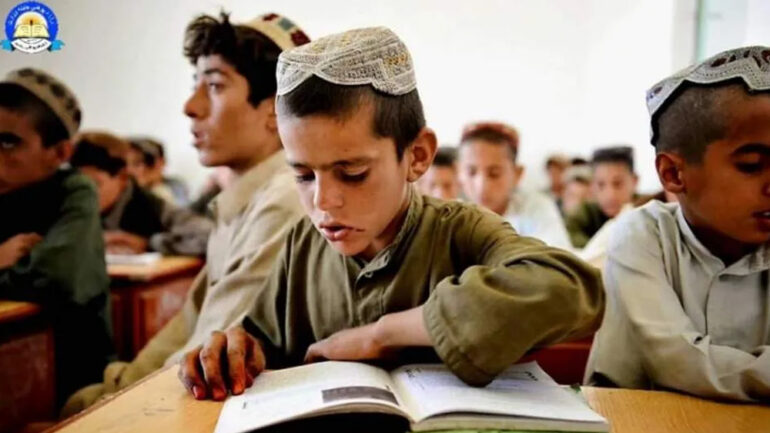
In contrast, the number of religious education institutions (madrasas) and their students has increased sharply. Religious schools increased from 1,127 in 2019 to 17,832 in 2023 and about 20,700 in 2025, according to figures from the Taliban’s Ministry of Education cited in the report. Enrolment in religious schools grew from 361,687 students in 2019 to about 2.46 million in 2025. Girls accounted for approximately 716,000 students, or 29% of the total.
The report also raises concerns about the quality of learning in public schools. A 2025 assessment of more than 55,000 fourth-grade pupils found that only 43.5% had reached minimum proficiency in language, while 25.4% met the minimum standard in mathematics. Girls who remained in school and took part in the assessment performed better than boys in both subjects.
Higher education curricula have also changed significantly. In 2025, public and private universities were instructed to remove 679 books and educational materials and discontinue 18 fields of study, including subjects related to human rights, democracy, gender, governance and other areas of social sciences, according to the report.
The number of university professors and lecturers fell from about 18,900 in 2019 to 12,700 in 2025, a reduction of roughly one-third. The decline was particularly pronounced among women. Afghanistan had approximately 2,600 female university professors and lecturers in 2019, but the figure fell to around 1,100 in 2023 and 800 in 2024. By 2025, just over 100 remained, the report says.
UNESCO and UNICEF warned that excluding women from higher education could limit the supply of qualified professionals in essential sectors, including health care, education and academia. The report estimated that if the restrictions continue, Afghanistan’s cumulative economic losses could reach about $9.6 billion by 2066.
The report also estimated that 7.1 million children would require emergency education support in 2026, citing displacement, natural hazards and large-scale returns from Pakistan and Iran. It said restoring girls’ access to education, strengthening teaching capacity and improving school facilities were essential to expanding opportunities for further study, skills development and employment.
Afghanistan’s education system has been in crisis since the Taliban returned to power in August 2021. The group banned girls from schooling beyond sixth grade, later extended the restrictions to universities, revised curricula to focus on religious subjects and built thousands of religious schools across the country.
UN agencies, international rights groups and education activists have warned that these policies risk leaving an entire generation without basic literacy, essential skills and future opportunities.