

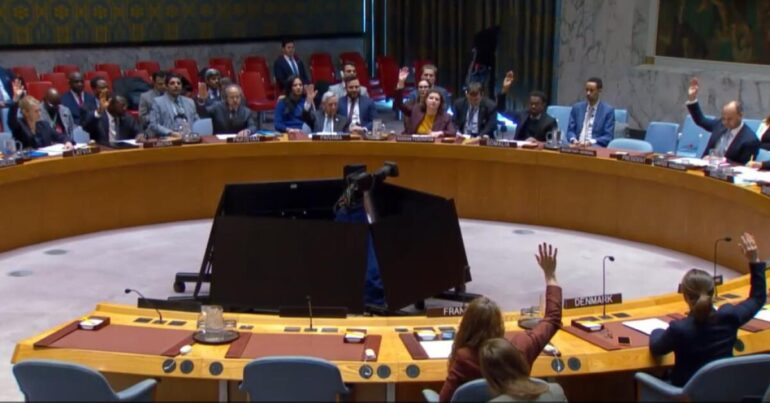

KABUL, AFGHANISTAN – The United Nations Security Council will hold a meeting to vote on the extension of the mandate of the United Nations Assistance Mission in Afghanistan (UNAMA).
The meeting will take place at 6:30 p.m. Kabul time tomorrow (Monday, June 15) and will be available to watch online.
On March 15 of the previous solar year, the United Nations Security Council extended UNAMA’s mandate in Afghanistan for three months, until June 17 of the current Gregorian year.
Prior to that, UNAMA’s mandate in Afghanistan had been extended annually. However, this year, due to opposition from the United States, the mandate was extended for only three months.
The United States Mission to the United Nations had argued that UNAMA is one of the most expensive political missions of the United Nations and operates in a complex environment. Therefore, it should be reviewed whether its current mandate remains appropriate and feasible.
The mission stated that a short-term extension of UNAMA’s mandate would provide an opportunity for discussions with all parties and allow the mission to be adapted to current conditions.
However, there were also concerns among members of the United Nations Security Council that a short-term extension of UNAMA’s mandate could weaken its position in Afghanistan.
The outcome of the Security Council’s vote is expected to be closely watched by international stakeholders, as UNAMA continues to play a key role in coordinating international engagement, monitoring developments, and supporting humanitarian and diplomatic efforts related to Afghanistan.
The United Nations Assistance Mission in Afghanistan (UNAMA) is a political and diplomatic mission established by the United Nations in 2002 to support peace, stability, and development in Afghanistan after the fall of the Taliban government.
Over the years, UNAMA has played a central role in coordinating international humanitarian aid, supporting political dialogue, monitoring human rights conditions, and assisting in efforts to strengthen governance and the rule of law in the country. It also works closely with Afghan civil society, international donors, and UN agencies to address issues such as civilian protection, women’s rights, and access to basic services.
UNAMA’s importance lies in its role as a neutral intermediary that helps facilitate communication between Afghanistan and the international community, while also documenting the evolving political and humanitarian situation on the ground. Despite operating in a complex and often unstable environment, it remains one of the key UN mechanisms for engagement in Afghanistan and a critical platform for international oversight and assistance.
If UNAMA’s mandate is not extended, the mission would gradually scale down or potentially end its operations in Afghanistan, which could significantly reduce the United Nations’ direct political and coordination presence in the country.
This would likely affect international monitoring of human rights, especially the situation of women and vulnerable groups, and could also weaken the coordination of humanitarian aid among UN agencies and international partners. Without UNAMA’s facilitation role, engagement between the international community and Afghanistan’s authorities could become more limited and fragmented, making diplomatic dialogue more difficult.
In addition, the absence of a UN political mission on the ground could reduce independent reporting and assessment of the country’s evolving political and security conditions, leaving a gap in international oversight at a critical time.

