


KABUL, AFGHANISTAN – The Taliban’s Ministry for the Promotion of Virtue and Prevention of Vice in Herat has imposed new restrictions on women’s movement and appearance, announcing that women who fail to comply with the group’s prescribed dress code will be arrested and transferred directly to prison.
According to audio messages obtained by KabulNow, the directive was communicated during a meeting with religious scholars in Herat on Thursday.
The enforcement process began on Saturday, June 6, and is being carried out by mobile inspectors from the Ministry for the Promotion of Virtue and Prevention of Vice, the Taliban police command, and intelligence personnel.
One of the audio messages states that Taliban mobile inspectors are patrolling the city and markets of Herat and will arrest any woman whose hair is visible in public.
Another message warns that if a woman is detained for allegedly violating hijab requirements and her guardian or a family member is employed by the government, that employee will be dismissed from their position.
A statement circulated by religious scholars who attended the meeting further declared that women who do not observe what the Taliban define as Islamic hijab will be collected by morality patrols and transferred to prison, adding that afterward “no one has the right to complain or object.”
The statement also noted that Taliban supreme leader Hibatullah Akhundzada had approved a plan for the implementation and clarification of what the group calls Sharia-compliant hijab. Under the policy, the employment of government officials whose wives or daughters do not comply with the prescribed dress code may also be suspended.
The Taliban had previously imposed extensive restrictions on women in Herat, including ordering public transport drivers not to carry women who are unaccompanied by a male guardian or those who do not wear the all-covering burqa. Under the Taliban’s morality law, women are required to cover their entire bodies, face coverings are considered necessary to prevent “temptation,” and women’s voices are classified as awrah, or something that should not be publicly heard.
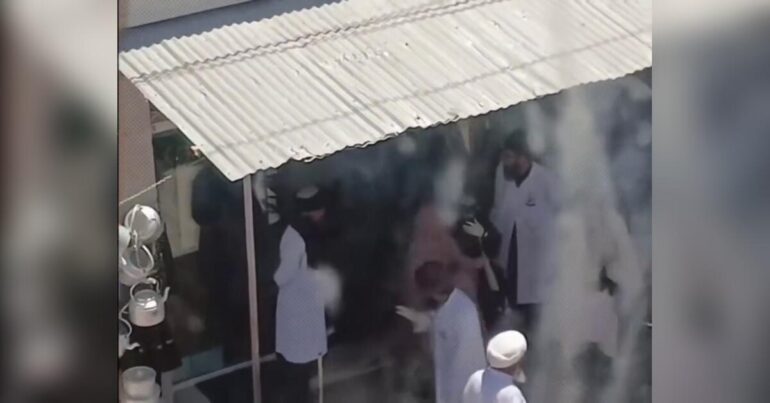
Meanwhile, Taliban morality police have reportedly detained several women and young girls in Herat’s Jebrail area for not wearing clothing deemed acceptable by the group. A video obtained by KabulNow shows Taliban personnel dressed in white uniforms forcing a woman into a vehicle. The exact number of women and girls arrested remains unclear.
Sources in Jebrail told the newspaper that Taliban morality officers have maintained a heavy presence in the area. One source said the officers arrived in a van and raided streets and markets. According to the source, they arrested a female shopkeeper in the Chahardah-Metri area of Jebrail.
Since the new restrictions were announced, a number of women and girls have reportedly been detained across different parts of Herat. Similar arrests over women’s clothing have previously been reported in Kabul and other Afghan cities. The dress code favored by the Taliban requires women to wear a burqa or black veil in a manner that completely conceals the face.
In response, the United Nations Assistance Mission in Afghanistan (UNAMA) expressed concern over the arrests and detentions of women in Herat for what it described as “non-compliance with dress requirements.” In a statement issued on Sunday, June 7, UNAMA said the arrests raise serious human rights concerns.
The UN mission reminded the Taliban authorities that all individuals have the right to freedom of movement and that women and men alike are entitled to equal protection under the law.
Furthermore, Nasir Ahmad Faiq, Afghanistan’s acting representative to the United Nations, condemned the arrests, saying that detaining women under the pretext of “improper hijab” is incompatible with Islamic principles as well as the customs and traditions of the Afghan people.
Faiq said he strongly denounces what he described as inhumane, unlawful, and un-Islamic actions. He questioned how Taliban morality officers consider themselves legitimate guardians of women while forcibly detaining and transporting them from streets and markets. please paraphrase the first line of this paragraph
Faiq also noted that credible and documented reports exist concerning violence, abuse, sexual assault in prisons, and forced marriages involving Taliban members—cases that, he said, have never been transparently investigated or adequately addressed.
He argued that the arrests form part of a systematic Taliban policy aimed at excluding women from society, stripping them of fundamental freedoms, and undermining their human dignity. According to Faiq, detaining women because of their clothing is not a defense of religion or values, but rather a tool for repression, intimidation, and the spread of fear throughout society.
Since taking power, the Taliban have imposed sweeping restrictions that have largely excluded women and girls from public life, including bans on secondary and higher education and severe limits on work, movement, and civic participation. UN experts and legal scholars have described the measures, taken together, as potentially amounting to gender persecution as a crime against humanity.

