

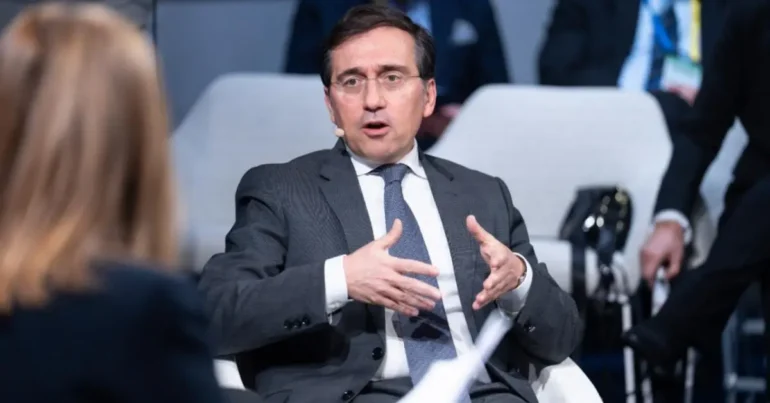

KABUL, AFGHANISTAN – José Manuel Albares, Spain’s Minister of Foreign Affairs, in the fifth meeting of European foreign ministers on feminist foreign policy, described the Taliban’s policies toward women in Afghanistan as “cruel and criminal.”
He said at this two-day meeting, held under the slogan “Building Peace and Democracy,” that the Taliban are engaged in a “criminal act” by attempting to silence the voices of Afghan women.
Albares, however, emphasized that Spain will always support Afghan women and will be their voice.
He referred, among other things, to an annual conference titled “Hear My Voice,” hosted by Spain’s Ministry of Foreign Affairs, which brings together Afghan women activists in exile, as well as the dedication of one of the ministry’s halls in the name of Afghan women, as examples of Spain’s support for women in Afghanistan.
The fifth meeting of European foreign ministers on feminist foreign policy was held in Spain with the participation of 140 civil society organizations and feminist groups, as well as representatives of civil society and women’s rights activists from around 60 countries around the world.
The meeting was held with the aim of strengthening gender equality, supporting peace, and protecting democratic values.
On the sidelines of the meeting, representatives of civil society organizations and women’s rights activists discussed “gender apartheid” and the role of women in the peace process in Afghanistan.
Fawzia Koofi, former member of the Afghan Parliament, spoke at the meeting about the role of Afghan women in future peacebuilding efforts and also reviewed the current situation of the country.
She said that today Afghan women and men are living in very difficult conditions, and that the policy of engagement and appeasement by European countries toward the Taliban has given them more power to suppress women.
Participants at the meeting emphasized that sustainable peace and democracy in Afghanistan cannot be achieved without the participation of women, and added that support for Afghan women should be part of global commitments to human rights, gender justice, and peace.
This meeting highlights the growing international recognition of the importance of feminist foreign policy in addressing human rights crises. It also reflects increasing global concern over the systematic exclusion of women from public life in Afghanistan and reinforces calls for stronger international mechanisms to ensure accountability and meaningful participation of women in peace and governance processes.
Since the Taliban returned to power in August 2021, the group has imposed sweeping restrictions on women and girls, effectively barring them from secondary and higher education, many forms of employment, and broad participation in public life. Women are also required to adhere to strict dress codes and need a male guardian for long-distance travel.
UN experts, international human rights organizations, and activists have described the systematic policies as “gender apartheid,” arguing they deliberately subjugate women and girls solely on the basis of gender. They have repeatedly called on the United Nations and world leaders to recognize gender apartheid as a crime against humanity under international law, though no formal legal proceedings have been launched to date.
The Taliban authorities defend their policies as consistent with their strict interpretation of Islamic law and have given no indication they intend to relax the measures despite mounting international criticism and pressure.

