

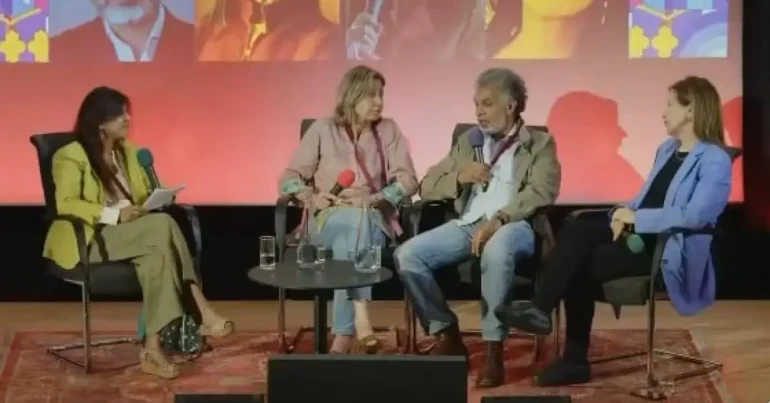

KABUL, AFGHANISTAN – Saad Mohseni, the owner of the Moby Group media network, has sparked public outrage with comments about the situation in Afghanistan, particularly regarding women. Some citizens have accused him of “whitewashing” the reality on the ground and acting as a “lobbyist” for the Taliban.
Speaking on Saturday (June 6) at the Jaipur Literature Festival in London, Mohseni claimed that conditions in Afghanistan are “normal” and that “women can walk around cities and drive without covering their faces.”
Mohseni said that his mother frequently travels to Kabul and has personally observed that conditions for women are “normal” and that “girls are going to school.”
At the very hours Mohseni was making these remarks in a luxury hall in London, the Taliban were reportedly detaining dozens of women from the streets of Herat for not covering their faces, placing them in military vehicles and transferring them directly to prison.
Several media outlets, citing witnesses, reported that the Taliban detained more than 40 women on Saturday. Among them was a female doctor who was reportedly arrested inside a hospital and taken to prison for “not wearing a burqa.”
Mohseni, who has previously called for engagement between the international community and the Taliban, did not condemn the Taliban’s detention of employees from his own outlet, TOLOnews.
He argued that reporting in Afghanistan is less challenging than in Gaza and suggested that journalists face mistreatment even in democratic settings such as the White House.
Mohseni had been invited to the event because of his new book, “Radio Free Afghanistan.” Also invited were BBC journalist Lyse Doucet for her book “The Finest Hotel in Kabul: A People’s History of Afghanistan,” and Christina Lamb, foreign editor of The Sunday Times, for her latest book, “The Burden of War on Women.”
Humaira Qaderi, an author and university lecturer, questioned the other panelists about why they did not hold Mohseni accountable for statements she described as contradicting reality.
Addressing Lyse Doucet, Christina Lamb, and the festival moderator, she questioned why Saad Mohseni—despite being fully aware of the hardships faced by Afghan women and primarily driven by business interests—was not held to account during the discussion.
Maryam Sama, a former member of Afghanistan’s parliament, described Mohseni as a “Taliban lobbyist.”
She accused Saad Mohseni of consistently promoting the Taliban’s interests, arguing that TOLOnews helped facilitate the republic’s collapse and the Taliban’s return. She further asserted that he has never supported freedom of expression, independent media, or women’s rights.
She also criticized the other panelists, saying: “Shame on those who sat at that table with him, like Lyse Doucet, the journalist, who at least as a woman stayed silent and said nothing and she is nodding while he speaks, which shows approval and agreement.”
Leila Mohammadi, a civil society activist, said Mohseni had turned Tolo, which was supposed to be a voice for truth and the people, into “a tool for justifying power and normalizing fundamentalism,” but that apparently “this was not enough,” and he had now resorted to “openly crafting narratives in favor of the Taliban.”
She added: “What a painful fall; from claims of journalism to prettifying reality to benefit a terrorist and misogynistic group!”
A women’s protest movement known as the Afghanistan Women’s Political Participation Network accused Mohseni of whitewashing the situation in favor of the Taliban.
The network said: “Saad Mohseni’s whitewashing of the Taliban on international platforms is complicity in censoring the voices of Afghan women.”
The movement added: “While under new laws, even women’s voices are banned in public spaces, Mr. Mohseni’s narrative of “freedom of movement” is nothing but an attempt to normalize a misogynistic regime.”
Khaled Qaderi, a photographer and journalist from Herat, angrily told Mohseni: “Just shut up!”
He added that “today in Herat, the Taliban arrested a pregnant woman simply because of “improper hijab” and took her to prison.”
Parwana Ebrahimi-Khail, a member of Afghanistan’s women’s protest movements, questioned why women on TOLOnws are not allowed to appear with uncovered faces if Mohseni’s claims are true.
She wrote: “Saad Mohseni says women in big cities especial in Kabul can go out without covering their faces and even drive. Yet on his own TOLOnews, women appear with stricter dress codes. What explains this contradiction?”
Journalist Mujib Mehrdad wrote that Mohseni had “crossed all moral boundaries.”
Calling for a stronger public response to such statements, he said: “I don’t know why people take a stance against Khalilzad, but they remain silent in the face of the whitewashing by this unscrupulous businessman?
Didn’t his television station come under attack just a few days ago?”
Sima Noori, an activist in the Afghan diaspora community in Europe, described Mohseni’s remarks as participation in the censorship of women’s voices.
She said: “Saad Mohsini’s whitewashing of the Taliban on international platforms is complicity in censoring the voices of Afghan women.”
Bismillah Taban, a former member of Afghanistan’s security forces, described Mohseni’s comments as “contrary to the visible reality” of Afghanistan.
He said: “This is not the first time that he has turned a blind eye to all the Taliban’s oppression and whitewashed this terrorist group. Winter passes, but shame clings like soot!”
However, Mohseni has so far not responded to the public anger and reactions, nor to accusations that he has been whitewashing the Taliban and lobbying on their behalf.
Since taking power, the Taliban have imposed sweeping restrictions that have largely excluded women and girls from public life, including bans on secondary and higher education and severe limits on work, movement, and civic participation. UN experts and legal scholars have described the measures, taken together, as potentially amounting to gender persecution as a crime against humanity.

